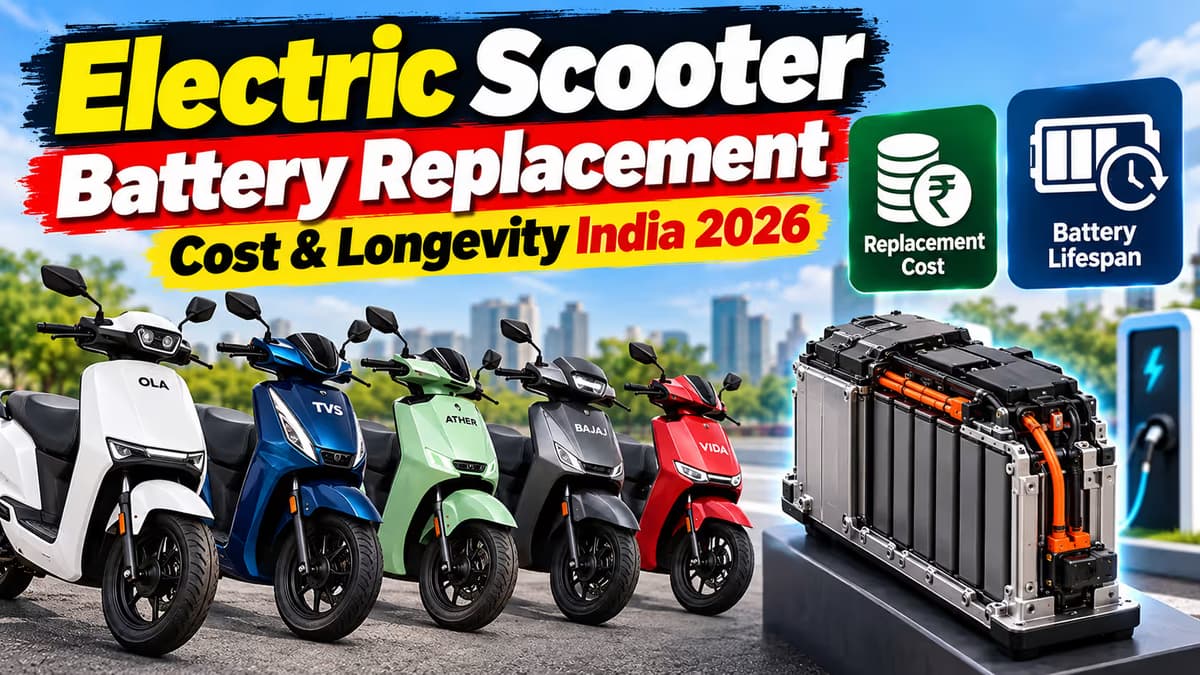
The Real Lifespan of an Electric Scooter Battery in India
As of October 2026, the biggest question for prospective electric scooter buyers in India remains: how long will the battery last, and what happens when it dies? The simple answer is that a modern, well-engineered electric scooter battery will realistically last you 6 to 8 years, or between 60,000 to 1,00,000 km, before its capacity degrades to a point where you'd notice a significant drop in range (around 70-80% of its original capacity). This is a significant improvement from older, generic Li-ion batteries which typically lasted only 3 to 5 years or 800 to 1,000 charge cycles in real-world Indian conditions.
The type of battery chemistry plays a crucial role. LFP (Lithium Iron Phosphate) batteries, known for their durability, are estimated to last 8 to 10 years or up to 1,20,000 km. In contrast, NMC (Nickel Manganese Cobalt) batteries, which are more common, are expected to perform well for 5 to 7 years or 60,000 to 80,000 km. For example, Komaki officially states its LiFePO4 (an LFP variant) batteries are rated for up to 2,500-3,000 cycles, far exceeding the lifespan of basic lithium-ion packs.
Understanding Battery Warranty: Your Financial Safety Net
Manufacturers have recognised buyer anxiety around battery life and are now offering extensive warranties. The industry benchmark for a warranty claim is when the battery's State of Health (SoH) drops below 70%. This means if your fully charged scooter that once gave 100 km of range now only gives 69 km, you are eligible for a replacement under warranty.
However, coverage varies significantly by brand and model, making it essential to read the fine print. Many are now offering extended warranties that can cover the vehicle for the majority of its useful life.
Manufacturer | Model(s) | Standard Warranty | Extended Warranty Options |
|---|---|---|---|
Ather Energy | Ather 450X | 3 years or 30,000 km | Up to 10 years or 1,00,000 km with 70% SoH assurance (via "Bedrock" and "Eight70" plans). |
Ola Electric | S1 Range | 3 years or 50,000 km | Up to 8 years or 1,25,000 km, guaranteeing health above 70%. |
Bajaj | Chetak | 3 years or 50,000 km | Up to 5 years or 70,000 km. |
TVS | iQube | 3 years / 50,000 km (large packs) or 3 years / 30,000 km (2.2 kWh) | A Battery-as-a-Service (BaaS) subscription offers a 5-year or 70,000 km extended warranty. |
Hero Vida | VX2 | 5-year battery warranty as standard on select trims. | N/A (Standard is long) |
Ampere | Ampere Nexus, Magnus Grand, G Max | 5-year or 75,000 km battery warranty. | N/A (Standard is long) |
What is the Actual Battery Replacement Cost in 2026?
If your battery fails outside the warranty period, the replacement cost is a significant expense, as the battery pack accounts for an estimated 35-50% of the scooter's total price. In 2026, expect to pay anywhere between ₹45,000 and ₹1,20,000, depending on the brand and battery capacity (measured in kWh).
- Ola Electric: The smaller 2 kWh battery in the Ola S1 X is estimated to cost around ₹45,000 to ₹50,000 to replace. The large 5.2 kWh pack in the S1 Pro+ is estimated to be ₹1,10,000 to ₹1,20,000.
- Ather Energy: The battery replacement for an Ather 450X is widely reported to be in the region of ₹50,000 to ₹65,000.
- TVS iQube: For the TVS iQube, costs vary from an estimated ₹45,000-₹50,000 for the 2.2 kWh variant up to a hefty ₹1,15,000-₹1,20,000 for the top-end 5.3 kWh ST variant.
- Bajaj Chetak: A replacement for the Bajaj Chetak is estimated to range from ₹55,000 (2.5 kWh pack) to ₹80,000 (3.5 kWh pack), excluding labour.
These figures highlight a clear trend: the larger the battery capacity (and thus, the longer the range), the more expensive it will be to replace.
Total Cost of Ownership (TCO): Petrol vs. Electric Scooter Over 7 Years
This is where the financial case for electric scooters becomes clear, even with the possibility of a battery replacement. Let's compare the total costs for a typical petrol scooter (like a TVS Jupiter) and an electric scooter over a 7-year, 70,000 km ownership period.
Assumptions for our calculation:
- Annual Usage: 10,000 km.
- Petrol Price: ₹102.12 per litre (as of Oct 19, 2026, in New Delhi).
- Petrol Scooter Mileage: 45 km/l (real-world average).
- Electricity Tariff: ₹9 per unit (estimated average for 2026).
- EV Running Cost: ₹0.25 per km (mid-point of the ₹0.20-₹0.30 real-world range).
- Upfront Cost Premium for EV: ₹20,000 (average of the ₹10,000-₹30,000 range).
TCO Breakdown: The Numbers Don't Lie
First, let's calculate the running cost per kilometer. For the petrol scooter, it's ₹102.12 / 45 km/l = ₹2.27 per km. For the electric scooter, we'll use the real-world figure of ₹0.25 per km.
Cost Component | Petrol Scooter (125cc) | Electric Scooter (Scenario 1: No Battery Replacement) | Electric Scooter (Scenario 2: Battery Replaced at 60,000 km) |
|---|---|---|---|
Upfront Purchase Price (Example) | ₹1,00,000 | ₹1,20,000 | ₹1,20,000 |
Fuel/Electricity Cost (70,000 km) | ₹1,58,900 | ₹17,500 | ₹17,500 |
Annual Maintenance (Estimated, x 7 years) | ₹14,000 (at ₹2,000/year) | ₹4,900 (at ₹700/year) | ₹4,900 (at ₹700/year) |
Battery Replacement Cost | N/A | ₹0 | ₹60,000 (Average estimate) |
Total Ownership Cost (7 Years) | ₹2,72,900 | ₹1,42,400 | ₹2,02,400 |
Total Savings vs. Petrol | - | ₹1,30,500 | ₹70,500 |
The analysis is stark. Over seven years, an electric scooter owner saves over ₹1.3 lakh if the original battery lasts the distance. Even in the worst-case scenario where a battery replacement is needed for ₹60,000, the owner still saves over ₹70,000 compared to running a petrol scooter. The initial ₹20,000 premium paid for the EV is typically recovered within 12 to 18 months just from fuel and maintenance savings.
Recommendations for Indian Buyers in 2026
1. Prioritise Warranty Over Everything: Don't just look at the scooter's price. A brand offering a 5, 8, or even 10-year battery warranty (like Ather, Ola, Hero Vida, or Ampere) provides a massive financial shield. This is more valuable than a few thousand rupees saved on the initial purchase from a brand with a basic 3-year warranty.
2. Match Battery Size to Your Usage: If your daily run is under 40 km, a scooter with a smaller battery pack (2-3 kWh) is sufficient. It will be cheaper to buy and cheaper to replace out-of-warranty. For heavy users or those who want to avoid range anxiety, a larger pack (4 kWh+) is better, but be prepared for a higher potential replacement cost down the line.
3. Consider LFP Batteries for Longevity: If you plan to keep your scooter for a very long time (8+ years), look for models that use LFP (LiFePO4) batteries. They are generally more durable and offer more charge cycles, making them a better long-term investment despite potentially being heavier.
4. Don't Fear Battery Degradation: A battery at 70% health after 7-8 years is not useless. If your daily commute is 30 km and your scooter's original range was 100 km, a degraded range of 70 km is still more than double what you need. You can continue using the scooter for many more years before a replacement becomes absolutely necessary.