What's The Big News?
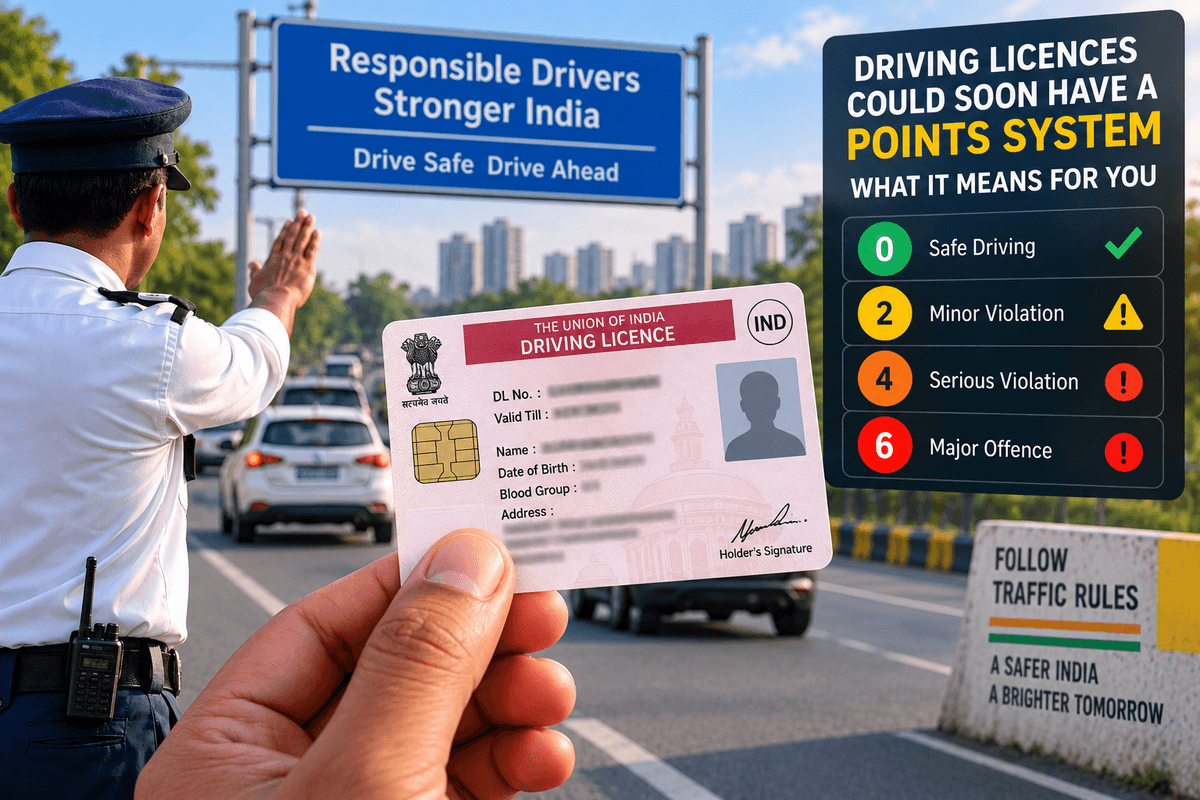
Alright folks, listen up. There's a big buzz going around the RTO corridors and it's something that could fundamentally change how we drive on Indian roads. The government is actively looking into implementing a points-based system for our driving licences, and even for vehicle registration certificates. This isn't just another fine; this is about holding us accountable for every single rule we break.
Think of it like this: for every traffic violation you commit, instead of just paying a challan and forgetting about it, you'd accumulate demerit points. Rack up too many of these points, and you could be looking at a suspended or even cancelled licence. It's a stark contrast to our current system, and honestly, it shows they're serious about making our roads safer. This isn't just about catching offenders; it's about preventing offences in the first place.
How This Points System Could Work for You (and Against You)
So, how would this actually play out? The idea is pretty straightforward. Minor infractions, like perhaps not using your indicator or a slight overspeeding, might get you a couple of points. More serious offences, like drunk driving, reckless driving, or jumping a red light repeatedly, would likely hit you with a much higher point penalty. The specific point values for each violation aren't out yet, but you can bet they'll be proportional to the danger they pose.
The interesting part is that your vehicle's Registration Certificate (RC) might also get linked. While the exact mechanism is still being discussed, it implies that certain violations tied to the vehicle itself, perhaps related to fitness or modifications, could also lead to penalties beyond just the driver. This holistic approach is meant to ensure both the driver and the vehicle meet safety standards. Now, what happens if you hit the maximum points? Well, that's when your driving privileges go for a toss. Your licence could be suspended for a period, or in severe cases, even cancelled outright. The good news? There's usually a way to get points removed over time through good driving conduct, perhaps after a certain period without any violations (yes, really). This incentivises better behaviour rather than just penalising bad behaviour.
Will This Make Indian Roads Safer? Or Just More Complicated?
Here's the million-dollar question: will this system actually work in India? On the one hand, a robust points system could be a game-changer. Imagine knowing that every time you cut a signal or try to overtake dangerously, you're not just risking a fine, but your very ability to drive. That's a powerful deterrent, especially in a country where the 'chalta hai' attitude sometimes dominates our roads. It could foster a culture of discipline and responsibility, ultimately leading to fewer accidents and smoother traffic flow. For too long, repeat offenders have managed to slip through the cracks; this system aims to stop that.
However, implementing such a system effectively in a country as vast and diverse as ours isn't going to be easy. Enforcement is key. We'll need widespread deployment of reliable technology – think more cameras, better ANPR (Automatic Number Plate Recognition) systems, and seamless integration between different enforcement agencies. There's also the challenge of public awareness and education; every driver needs to understand the rules of the new game. And yes, the elephant in the room: the potential for corruption. A system like this needs to be absolutely transparent and tamper-proof to build public trust. Without that, it risks becoming just another layer of bureaucracy.
Specs At A Glance
Feature | Details |
|---|---|
System Type | Demerit Points System |
Applicability | Driving Licence (DL), Vehicle Registration Certificate (RC) |
Objective | Improve driver behaviour, reduce traffic violations |
Point Allocation | Varies per violation severity (Expected) |
Consequence of Max Points | Licence Suspension/Cancellation (Expected) |
Point Reset | Likely after a period of good conduct (Expected) |
Implementation Timeline | Under consideration; no official date (TBA) |
Governing Body | Ministry of Road Transport and Highways (MoRTH) |
How Does It Stack Up Against the Current System?
Currently, traffic enforcement in India largely relies on immediate fines (challans) for violations. While serious offences can lead to licence suspension, it's often a more complicated, drawn-out process and not consistently applied for cumulative minor infractions. You pay the fine, maybe attend a court hearing, and usually, you're back on the road. There isn't a continuous, cumulative record that directly impacts your driving privilege based on repeated bad behaviour.
The points system, on the other hand, is designed to be cumulative and proactive. It tracks your driving history over time. Instead of just a one-off penalty, every violation contributes to a larger consequence. This is a crucial difference. It moves beyond merely penalising an act to penalising a pattern of unsafe driving. It's a much more robust approach than simply issuing challans, which many drivers just treat as another 'tax' for driving.
The Good And The Not-So-Good
What We Like
- Stronger deterrent for repeated traffic violations and reckless driving.
- Promotes a culture of safer and more disciplined driving habits on Indian roads.
- Potential for increased transparency and accountability in traffic enforcement.
- Effectively addresses the issue of habitual offenders who often escape severe consequences.
- Could lead to a significant reduction in road accidents and fatalities over time.
What Could Be Better
- Implementation will be a massive challenge across a diverse and populous country like India.
- Risk of corruption needs to be mitigated with robust, technology-driven solutions.
- Requires extensive public awareness campaigns and clear communication to avoid confusion.
- Doesn't directly address underlying infrastructure issues that sometimes contribute to violations.
- Initial period could see significant resistance and confusion from drivers.
When Can We Expect This To Roll Out?
As of now, this points system is still in the 'consideration' phase. The government is evaluating various models and consulting stakeholders. There's no official timeline for its rollout yet, and it's likely to require significant legislative changes before it can be implemented. Don't expect it to appear overnight; such a monumental shift will take careful planning, pilot programs, and possibly a phased approach. Keep an eye on the Ministry of Road Transport and Highways for official announcements.
Our Verdict
Look, the current state of road safety in India isn't something to be proud of. We need drastic measures to curb the alarming number of accidents and fatalities. A points-based system for driving licences and RCs holds immense promise in instilling discipline and accountability among drivers. It's a move that many developed nations have successfully adopted to make their roads safer, and there's no reason why India can't do the same.
Honestly, this is a much-needed step, but the devil will truly be in the details of its execution. If implemented with transparency, strong technological backing, and proper public education, it could very well be the turning point we desperately need for safer Indian roads. Let's hope the government gets this right; our lives literally depend on it.