What's The Big News?
For years, the Bajaj Pulsar 150 has been the undisputed king of the affordable performance segment, a bike that introduced a whole generation to the thrill of motorcycling without breaking the bank. It's the bike everyone either owned, or dreamt of owning, at some point. But let's be honest, while its reliability and legacy are solid, the old warhorse was starting to feel its age, especially against a flurry of newer, more tech-packed rivals.
Well, it looks like Bajaj is finally listening to what enthusiasts have been asking for. Rumours have been swirling, and fresh images suggest a significant update is on the horizon for the venerable Pulsar 150. This isn't just a sticker job; we're talking about a proper refresh that aims to bring one of India's most beloved motorcycles firmly into the modern era. So, if you've been holding out for a fresh Pulsar 150, your patience might just pay off.
The Pulsar's New Avatar: What to Expect in Design & Features
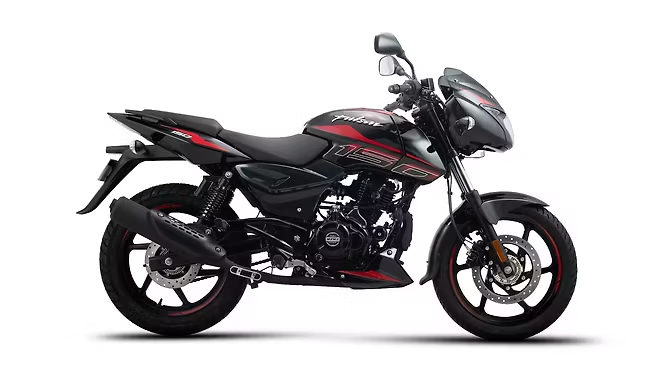
So, what's actually new? From what we've gathered, the updated Pulsar 150 is expected to sport a sharper, more contemporary design while retaining that iconic Pulsar silhouette. We're talking about a revised headlamp unit – possibly full LED, which would be a welcome change from the dated halogen setup – along with sleeker body panels and updated graphics. Expect a more aggressive tank design and a slightly tweaked tail section to give it a fresh appeal that aligns with Bajaj's current design language.
Beyond the refreshed aesthetics, the feature list is where Bajaj really needs to step up. We're anticipating a fully digital instrument cluster, a significant upgrade from the current semi-digital unit. Bluetooth connectivity, offering turn-by-turn navigation and call/SMS alerts, could also be on the cards, a feature that's becoming increasingly common even in this segment. Single-channel ABS is pretty much a given for safety, but we're hoping for slightly better switchgear quality and perhaps even a USB charging port – small touches that make a big difference in daily usability, especially for the price of a mid-spec Swift.
Under the Hood: Engine Refinements and Performance Expectations
Now, let's talk about the heart of the matter – the engine. The Pulsar 150's 149.5cc air-cooled DTS-i engine has been a workhorse, known for its decent grunt and impressive fuel economy. For this new iteration, we don't expect a complete overhaul, but rather significant refinements. Bajaj will likely focus on making it smoother, more tractable in city traffic, and perhaps squeeze out a tad more power and torque to keep up with the competition. BS6 Phase 2 compliance is, of course, a mandatory upgrade, ensuring cleaner emissions.
We're hoping for better throttle response and a more refined gearbox feel. The Pulsar 150 has always been about accessible power, not outright speed, and that character will likely remain. Expect it to be a comfortable commuter with enough highway capability for those occasional long rides. The suspension setup is expected to remain the tried-and-tested telescopic forks upfront and twin Nitrox shock absorbers at the rear, offering that familiar comfortable ride quality that Pulsar owners swear by.
Specs At A Glance
Feature | Expected Specification |
|---|---|
Engine Type | Single Cylinder, Air-Cooled, DTS-i |
Displacement | 149.5cc |
Max Power | TBA |
Max Torque | TBA |
Gearbox | 5-speed Manual |
Front Brake | Disc |
Rear Brake | Drum / Disc (Optional) |
ABS | Single Channel (Standard) |
Front Suspension | Telescopic Forks |
Rear Suspension | Twin Shock Absorber with Nitrox |
Fuel Tank Capacity | TBA |
Headlamp | Halogen (Expected LED on higher variant) |
Tail lamp | LED |
Instrument Cluster | Full Digital (Expected) |
Wheels | Alloy |
How Does It Stack Up Against The Competition?
Now, let's talk about the competition. The 150-160cc segment is a shark tank, isn't it? The updated Pulsar 150 will go head-to-head with established rivals like the TVS Apache RTR 160 2V, the Honda Unicorn, and the Hero Xtreme 160R. The Apache RTR 160, with its sharper handling and slightly more performance-oriented engine, often appeals to younger riders. The Unicorn, on the other hand, is known for its bulletproof reliability and smooth, refined engine – a true no-nonsense commuter.
Where the Pulsar 150 needs to differentiate itself is by offering a compelling blend of modern features, comfortable ergonomics, and that classic Pulsar 'feel' without compromising on its core value proposition. If Bajaj prices it right and packs in the expected features, it could easily reclaim some lost ground. The Xtreme 160R offers a more modern, premium feel, so the Pulsar 150 really needs to up its game on fit-and-finish and overall build quality. Honestly, this segment is all about perception and value, and the new Pulsar has to deliver on both fronts to stand out.
The Good And The Not-So-Good
What We Like
- Expected modern design updates, finally!
- Likely to retain the comfortable ergonomics and ride quality.
- Refined DTS-i engine character for city commuting.
- Potential for a full digital console and connectivity features.
- Bajaj's widespread service network and parts availability.
- That classic Pulsar feel, but with a fresh twist.
What Could Be Better
- Still an air-cooled engine; could benefit from oil-cooling for better heat management.
- Unlikely to get premium components like USD forks or a perimeter frame.
- Potential for a significant price hike might dilute its value proposition.
- Hoping for better brake feel and overall refinement than the current model.
- We'd love to see a more substantial power bump to truly challenge rivals.
Price & When You Can Buy It
Speaking of your wallet, the big question is always about the pricing. While official figures are yet to be revealed, we expect the updated Bajaj Pulsar 150 to be priced slightly higher than the current model, given the expected feature and design upgrades. We’re anticipating a price tag in the ₹1.10 – 1.25 lakh (ex-showroom) range, depending on the variants and features offered. This would keep it competitive within its segment, but also push it closer to 160cc bikes, which is something Bajaj needs to manage carefully.
As for when you can get your hands on it, whispers suggest a launch is imminent. We're looking at a possible release in the coming months, perhaps before the festive season kicks into full swing. Bajaj usually likes to make a splash with its Pulsar launches, so keep an eye out for official announcements and dealer dispatches. You'll want to check it out in person, trust me.
Our Verdict
Ultimately, the Bajaj Pulsar 150 is more than just a motorcycle; it's an emotion for many Indian riders. This expected update feels like a much-needed breath of fresh air for a legend that was starting to fade a bit. If Bajaj manages to blend its traditional strengths – reliable engine, comfortable ride, and aggressive pricing – with modern features and aesthetics, they could have another winner on their hands. It’s a delicate balance, updating a classic without losing its soul.
Here's the thing — for a bike that sells purely on its legacy, this update needs to be more than just skin deep. It needs to genuinely improve the riding experience and offer tangible value over its rivals, not just look fresh. If they pull that off, the new Pulsar 150 will be ready to reclaim its throne, one enthusiastic ride at a time. We'll be riding it soon to give you the full scoop, so stay tuned!