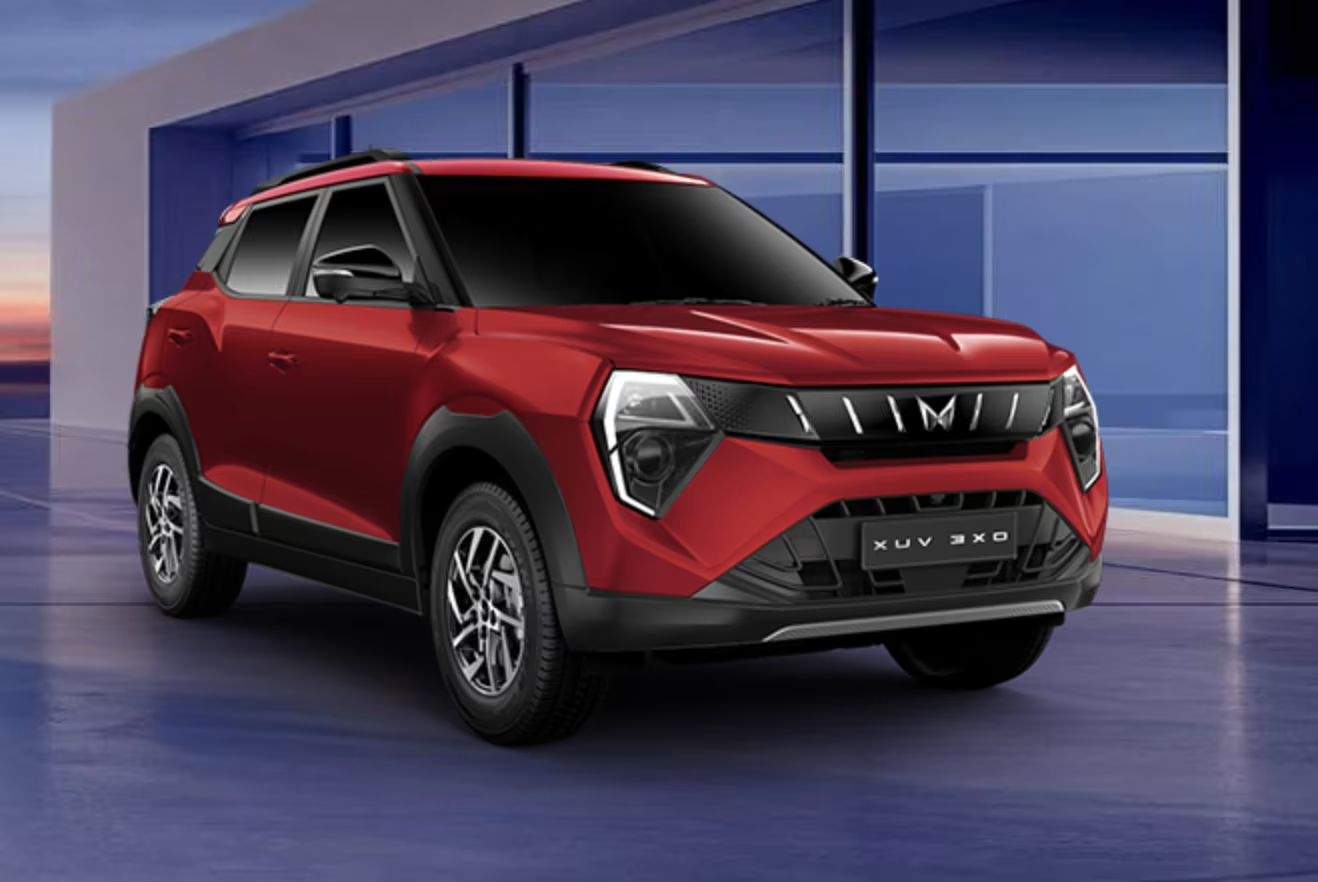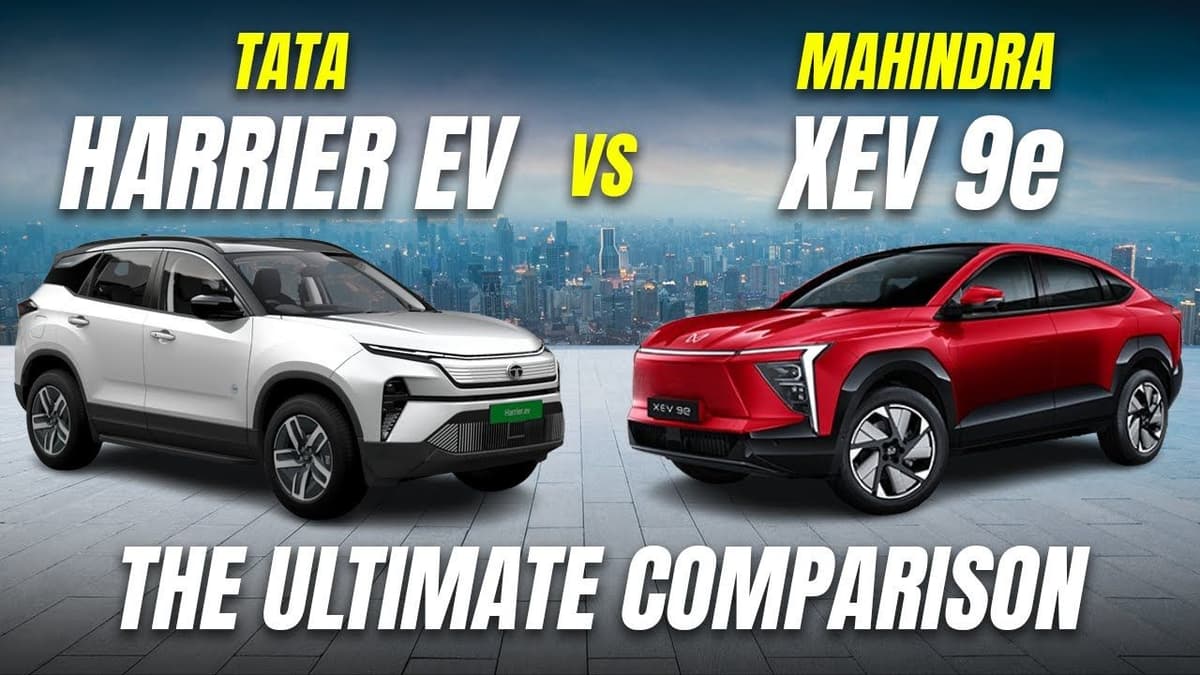
The premium EV SUV segment in India is heating up, and it’s not international brands leading the charge — but homegrown giants. Mahindra and Tata, the same rivalry we’ve seen with the XUV700 and Harrier, is now playing out in the electric space with the Tata Harrier EV and the Mahindra XEV 9e.
Both sit close to the ₹30 lakh segment, both pack serious tech, and both promise real-world long-distance capability. But only one can claim the title of the better buy.
Price and Variant Positioning
Both SUVs overlap in price, but their configuration strategies differ.
| Model | Powertrain Available | Battery Options | Price Range (Ex-Showroom) |
|---|---|---|---|
| Tata Harrier EV | RWD / AWD (Dual-Motor) | 65 kWh / 75 kWh | ₹21.49–₹28.99 lakh |
| Mahindra XEV 9e | RWD | 59 kWh / 79 kWh | ₹21.90–₹30.50 lakh |
Mahindra offers bigger battery options, while Tata offers more drivetrain versatility with its AWD variant.
Design and Road Presence
These two EVs follow completely different philosophies:
Tata Harrier EV stays close to the original Harrier — muscular, upright, and unmistakably SUV-like.
Mahindra XEV 9e looks futuristic and coupe-inspired, similar in vibe to global EVs like the Volvo EX30 and Tesla Model Y.
Size Comparison
| Spec | Harrier EV | XEV 9e |
|---|---|---|
| Length | 4607 mm | 4789 mm |
| Width | 2132 mm | 1907 mm |
| Height | 1740 mm | 1694 mm |
| Wheelbase | 2741 mm | 2774 mm |
| Boot Capacity | 502L + 35L frunk | 663L + 150L frunk |
The Mahindra is longer and offers better boot practicality, while the Tata feels broader and more traditional SUV-ish.
Cabin Experience & Comfort
Step into the Harrier EV and the first thing you notice is the premium 14.5-inch Samsung QLED touchscreen — bright, crisp, and responsive. The cockpit feels familiar yet modern.
The Mahindra takes a different approach, using a three-screen layout stretched across the dashboard. It looks futuristic, though the UI takes some time to learn.
Interior Highlights Comparison
| Feature | Harrier EV | XEV 9e |
|---|---|---|
| Screen Setup | 14.5" + digital cluster | Triple screen layout |
| Seat Ventilation | Easy physical controls | Hidden in menus |
| HUD | ❌ No | ✅ Yes |
| Rear Seat Recline | ❌ No | ✅ Yes |
| 2nd Row Space | Good | Better headroom could be improved |
Storage practicality clearly favors Mahindra — that 663-litre boot + large frunk is unmatched in this segment.
Performance and Driving Dynamics
Numbers tell one story, on-road feel tells another.
Acceleration & Specs
| Metric (0–100 km/h) | Harrier EV AWD | Mahindra XEV 9e |
|---|---|---|
| Power | 313 hp (Dual Motor) | 286 hp |
| 0–100 km/h | 6.74 sec | 7.45 sec |
| Top Speed | 180 km/h | 200+ km/h |
| Drive System | AWD | RWD |
The Harrier EV is quicker, but the XEV 9e feels smoother and more responsive, especially in city driving.
Handling Feel
The Harrier EV feels stable but gets floaty at high-speed highways.
The XEV 9e feels lighter and far more maneuverable — helped by its variable steering ratio and tight turning radius.
Real-World Range & Charging
Claimed range figures often matter less than tested numbers — and here’s where things get interesting.
| Category | Harrier EV | XEV 9e |
|---|---|---|
| City Efficiency | 5.5 km/kWh | 5.4 km/kWh |
| Highway Efficiency | 5.2 km/kWh | 6.2 km/kWh |
| Real-world Tested Range | 401 km | 456 km |
| Max DC Fast Charging | 107 kW | 175 kW |
| AC Charger Included | Optional | Optional (7.2kW/11.2kW) |
Mahindra clearly has the range and charging advantage, especially on highways — a key factor for EV buyers.
Which EV Offers Better Value?
Both are strong contenders — and choosing one depends on what matters more to you.
| Buyer Type | Best Pick |
|---|---|
| Want AWD + fastest acceleration | Tata Harrier EV |
| Need maximum range + boot space | Mahindra XEV 9e |
| Prefer intuitive touchscreen UX | Harrier EV |
| Want futuristic cabin design | XEV 9e |
| Best long-distance EV | XEV 9e |
| Best pricing logic | Harrier EV |
Verdict
Both SUVs prove that Indian EV engineering has come a long way — enough to rival models like the MG ZS EV, Kia EV6, BYD Seal U and Hyundai Creta EV (upcoming).
But if we have to choose one winner based on overall usability, tech polish, range, comfort, and charging capability:
The Mahindra XEV 9e edges ahead.
It feels more futuristic, offers more space, charges faster, and delivers proper long-distance confidence — making it the more future-ready EV.
FAQs
Q1. Which EV has the best real-world range?
➡ Mahindra XEV 9e (around 456 km tested).
Q2. Is AWD worth it on the Harrier EV?
➡ Yes, if you drive in hilly or rough terrain. For most users, RWD is sufficient.
Q3. Which has the better infotainment system?
➡ The Harrier EV is easier to use, while the XEV 9e looks flashier but has a learning curve.
Q4. Will fast charging damage the battery?
➡ Occasional DC fast charging is fine — both cars use modern thermal management and LFP/NMC chemistry designed for longevity.
Q5. Should I wait for Tata Curvv EV or Hyundai Creta EV?
➡ Only if budget is lower. In the ₹25–30 lakh bracket, these two remain top picks today.