What's The Big News?
Remember the raw, boxy Tata Sumo? That workhorse which ruled Indian roads, carrying entire families and mountains of luggage across states? If you grew up in the 90s or 2000s, you've definitely sat in one, probably on a bumpy mountain road while gulping down a cutting chai at a pitstop. It was basic, it was noisy, but it was absolutely unstoppable.
Now, rumours are suddenly catching fire across the internet that Tata Motors is seriously considering resurrecting this legendary nameplate. With the SUV craze at an all-time high in India, bringing back a rugged, no-nonsense utility vehicle could be a masterstroke to challenge Mahindra's absolute monopoly in the rural and semi-urban markets.
The Modern Avatar: Boxy Heritage Meets New-Age Tech
Let's talk about how Tata might pull this off without making it look like a relic from the past. The original Sumo was a pure body-on-frame beast, built to take a beating on the worst roads imaginable. If Tata brings it back, they face a massive engineering puzzle. Will they stick to a rugged ladder-frame chassis, or will they adapt their versatile ALFA or OMEGA platforms to keep development costs in check?
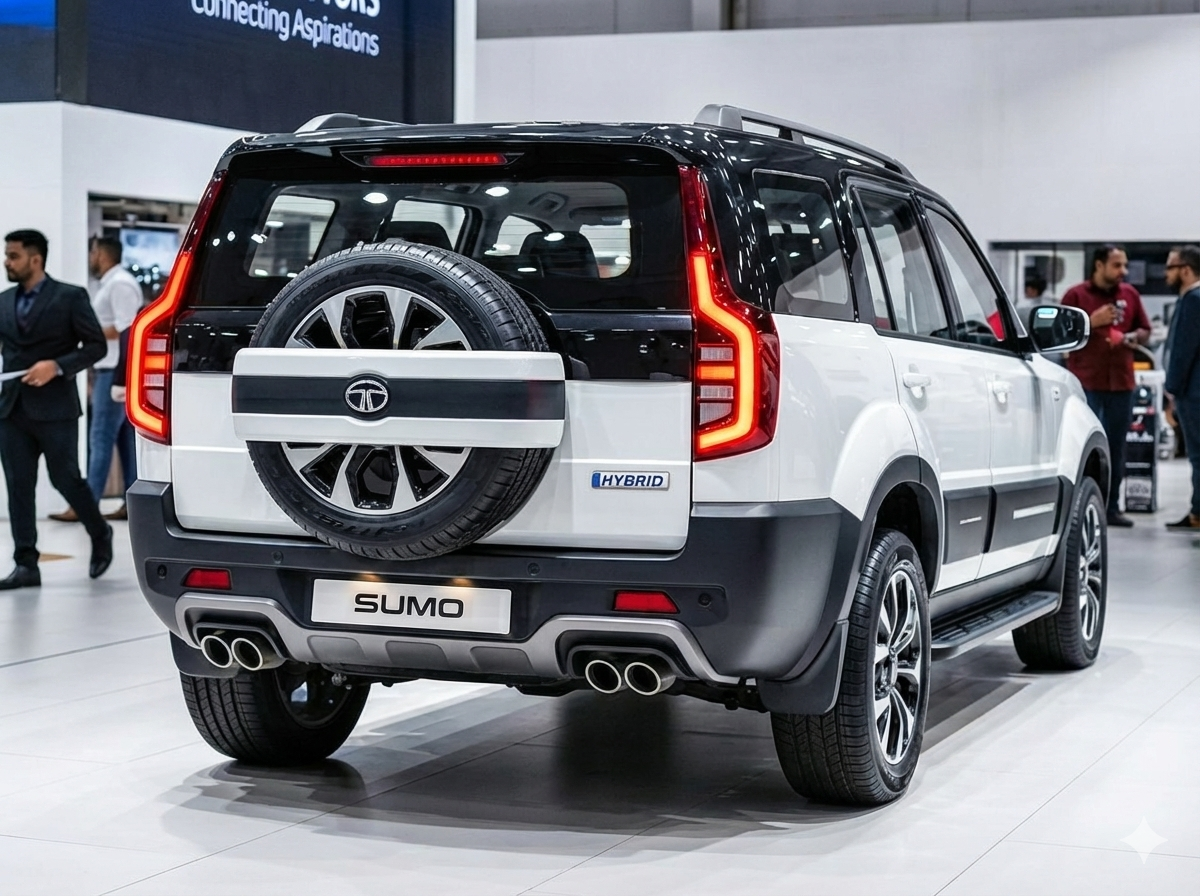
We expect a design that pays heavy tribute to the classic boxy silhouette. Think of a bold, squared-off stance, high ground clearance, and an upright tailgate with a spare wheel mounted on it. But step inside, and you'll find a world that the old Sumo driver could only dream of. Tata won't give you a bare-bones cabin anymore. Instead, expect a modern touchscreen infotainment system, a digital instrument cluster, and decent safety tech, because today's buyer won't touch a car without a rear-view camera and at least six airbags.
The Engine Room: What Will Power the New Sumo?
Powering this heavy-duty machine won't be the noisy old diesel clatterer of yore. Tata's modern 1.5-litre Kryotec diesel, or even a detuned version of the Safari's 2.0-litre engine, makes a ton of sense. Alternatively, they could offer their new 1.2-litre turbo petrol engine to keep the starting price incredibly aggressive—perhaps even matching the price of a mid-spec Swift to lure buyers away from hatchbacks.
Don't rule out an electric version either. Tata's EV game is incredibly strong right now, and a Sumo.ev would be a wild but highly logical move for fleet operators who need a robust people-mover without the crushing running costs of diesel. Imagine a silent, torque-heavy Sumo climbing steep mountain passes with ease. It sounds futuristic, but in today's market, it's highly possible.
Specs At A Glance
Since the vehicle is yet to be officially revealed, many specifications remain speculative. Here is what we expect based on current market trends and Tata's existing parts bin:
Feature / Parameter | Expected Specification |
|---|---|
Platform | Modified Ladder-Frame or OMEGA-Arc (TBA) |
Engine Options | 1.5L Diesel / 1.2L Turbo Petrol (Expected) |
Transmission | 6-Speed Manual / 6-Speed Automatic (Expected) |
Seating Capacity | 7 to 9-seater configurations |
Expected Ground Clearance | 200mm+ |
Expected Launch Timeline | Late 2025 or 2026 (Speculated) |
How Does It Stack Up Against The Competition?
To understand the Sumo's potential success, we have to look at the undisputed king of rural India: the Mahindra Bolero. Mahindra has been dominating this space for decades (and honestly, it shows in how little they've updated the platform). The Bolero is tough, cheap to repair, and has massive brand equity. If Tata wants to dethrone it, the new Sumo needs to be just as rugged but offer significantly better cabin comfort and ride quality.
Then there's the Maruti Suzuki Ertiga. While the Ertiga is a soft, highway-biased MPV, many buyers choose it simply because there is no other reliable 7-seater at that price point. A rugged Sumo with modern features could easily steal those buyers who want a vehicle that can handle broken village roads without scraping its belly every time they carry a full load of passengers and luggage.
The Good And The Not-So-Good
What We Like
- Massive nostalgia value that instantly connects with millions of Indian buyers
- Potential for a spacious, high-riding cabin that can easily seat 7-9 people
- Tata's modern safety standards mean it will likely target a high Bharat NCAP rating
- Rugged styling that stands out in a crowd of soft roaders
What Could Be Better
- Body-on-frame dynamics might feel agricultural if not tuned well
- Stiff competition from established rivals like the Bolero and Ertiga
- Tata's after-sales service quality remains a hit-or-miss experience for many
Price & When You Can Buy It
Since Tata Motors hasn't officially confirmed the launch timeline or pricing, we have to look at the market gaps. If this project gets the green light, we expect the new Tata Sumo to be priced in the ₹8.5 lakh to ₹14 lakh range (ex-showroom). This would place it squarely against the Bolero Neo and the lower variants of the Ertiga. As for the launch, if the rumours are true, we might see a concept showcase or an official announcement sometime in late 2025 or early 2026.
Our Verdict
Look, the Indian car market loves a comeback story, but nostalgia alone won't sell cars today. We've seen legendary names return and fail if the product wasn't right. If Tata can balance the rugged, unstoppable charm of the original Sumo with modern refinement and safety, they have a massive winner on their hands. It shouldn't just be a sticker job; it needs to be a proper, tough-as-nails utility vehicle that can handle our chaotic roads.