What's The Big News?
Alright folks, listen up! If you've been dreaming of an electric car but felt like your wallet needed a serious upgrade first, I've got some potentially game-changing news for you. Our sources tell us that Hyundai and Kia, two of the biggest players in the Indian automobile scene, are seriously pushing ahead with plans to introduce a whole lineup of "affordable" electric vehicles for our market.
This isn't just about another premium EV for the select few. We're talking about models designed from the ground up to hit a sweet spot in pricing, making electric mobility a real possibility for the average Indian car buyer. It’s a huge strategic shift from both brands, and honestly, it shows they're finally paying attention to what the everyday customer wants: value, reliability, and an EV that doesn't cost an arm and a leg.
The Strategy: Making EVs Accessible
So, what exactly does "affordable" mean in the Hyundai and Kia context? While specific models are still under wraps, the buzz suggests a multi-pronged approach. We're likely to see a mix of compact SUVs and possibly even a hatchback or two, all built with significant localization to keep costs down. This isn't just about putting a smaller battery in an existing ICE car; it's about dedicated EV platforms, or heavily modified ones, engineered for efficiency and cost-effectiveness right here in India.
Think about it: both Hyundai and Kia have already proven their mettle with models like the Kona Electric and the EV6, respectively. They know the technology, they understand the Indian market's demands for features, and crucially, they have the manufacturing muscle. Bringing that expertise to a more budget-friendly segment is a massive undertaking, but if anyone can pull it off while still offering their signature quality, it's these two Korean giants. They're not just throwing darts; they've got a proper plan to attack the mass-market EV segment.
Localisation & Battery Tech: The Cost-Cutting Keys
Here's the thing — for any EV to truly be "affordable" in India, a high degree of localisation is non-negotiable. Importing everything drives prices sky-high, as we've seen with some initial EV offerings. Hyundai and Kia are well aware of this. We're hearing that they’re looking at localizing not just assembly, but also key components, and especially battery pack assembly. This isn't a small feat, but it's the only way to get those ex-showroom prices down to where a family can actually consider an EV for the price of, say, a top-spec Creta or Seltos.
Furthermore, the choice of battery chemistry will be critical. While high-performance EVs might use NMC (Nickel Manganese Cobalt) batteries, expect these affordable models to lean heavily towards LFP (Lithium Iron Phosphate) cells. LFP batteries are generally safer, more durable, and significantly cheaper to produce, even if they offer slightly lower energy density. For daily city commutes and even occasional highway runs, the range they'll offer should be perfectly adequate for the target audience. It's a smart compromise that prioritizes affordability and longevity, which is exactly what our market needs.
Specs At A Glance
Feature | Expected Details |
|---|---|
Body Style | Compact SUV, Hatchback (expected) |
Battery Chemistry | LFP (Lithium Iron Phosphate) likely |
Range (claimed) | Expected around 300-400 km (ARAI) |
Motor Type | Front-mounted permanent magnet synchronous motor (expected) |
Charging | AC & DC fast charging support (TBA for exact speeds) |
Launch Timeline | Expected in the next 1-2 years |
How Does It Stack Up Against The Competition?
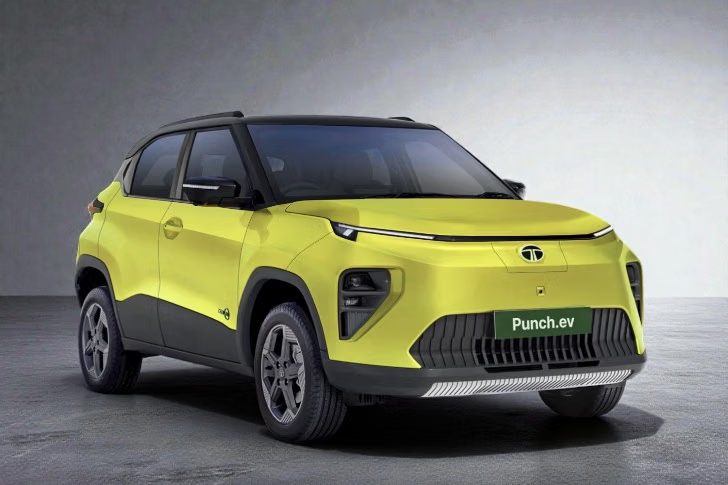
Currently, the "affordable" EV segment in India is dominated by Tata Motors with their nexon-ev">Nexon EV and tiago-ev">Tiago EV, and to some extent, MG with the Comet EV. The Nexon EV Prime and Max have set a benchmark, offering decent range and features for their price point. The Tiago EV, on the other hand, is the most accessible entry into the electric car world. MG's Comet is a quirky, urban-focused offering.
If Hyundai and Kia manage to price their new offerings competitively, say in the ₹10-15 lakh bracket, they'll be direct rivals to the Nexon EV and potentially even offer a more premium, feature-rich alternative to the Tiago EV. Their advantage could lie in refinement, interior quality, and perhaps a more comprehensive charging network support, leveraging their existing service infrastructure. Honestly, this competition is a good thing for us buyers; it pushes everyone to innovate and offer better value. Maruti's also got plans, but for now, these two seem to be moving faster in the mass-market EV space.
The Good And The Not-So-Good
What We Like
- Accessibility: Finally, major players are focusing on truly affordable EVs for the masses.
- Quality & Features: Hyundai and Kia typically offer a strong package of features and robust build quality, which should trickle down.
- Market Disruption: More competition means better products and pricing for consumers. About time, Maruti!
- Charging Infrastructure: Leveraging existing dealer networks could mean better service and charging solutions.
- Safety Focus: Expected to maintain high safety standards, a crucial point for Indian buyers.
What Could Be Better
- Actual Pricing: The biggest unknown. Will they truly hit that "affordable" sweet spot, or will it be "affordable for a Hyundai/Kia"?
- Range Anxiety: While LFP is good for cost, ultimate range might still be a concern for some highway users if batteries are too small.
- Charging Speeds: To truly compete, robust fast-charging capabilities need to be standard, not just an expensive option.
- Initial Availability: Hyundai/Kia often have long waiting periods for popular models; hope these EVs don't suffer the same fate.
Price & When You Can Buy It
As of now, specific pricing details are obviously under wraps, given that we're talking about future models. However, the consistent emphasis on "affordable" suggests that Hyundai and Kia are aiming for a starting price point that undercuts their current EV offerings significantly. We expect pricing for their entry-level affordable EVs to be in the ₹10–15 lakh (ex-showroom) range, which would make them direct competitors to the current crop of mass-market EVs.
When can you get your hands on one? While no official launch timelines have been announced, industry insiders suggest we could see the first of these new affordable EVs hitting our showrooms within the next 18 to 24 months. Both brands are known for their aggressive product strategies, so once they greenlight something, they move fast. Keep your eyes peeled and your savings ready!
Our Verdict
This news about Hyundai and Kia diving head-first into the affordable EV segment is monumental for the Indian market. For years, electric cars have been a niche luxury, largely out of reach for the typical Indian family. The entry of these two powerhouses, with their focus on localization and cost-effective battery tech, signals a genuine shift towards democratizing electric mobility. It’s not just about selling cars; it’s about making a sustainable future a tangible reality for more people.
In my opinion, if they get the pricing right – truly right, not just "Hyundai-Kia affordable" – and back it up with their typical strong features and robust service network, these upcoming EVs could very well be the catalyst that electrifies India's roads at an unprecedented pace. It’s an exciting time to be an Indian car enthusiast, isn't it?