What's The Big News?
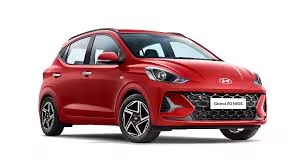
Phew, alright, so Hyundai's finally spilled some beans about the Grand i10 Nios. And what a mouthful it is: a brand-new generation is officially confirmed for India. This isn't just a minor nip-and-tuck; we're talking about a complete overhaul for one of the most popular hatchbacks on our roads.
But here's the kicker, and you might want to sit down for this: it's slated to arrive by 2030. Yes, really. That's a fair few years away, meaning the current Nios still has a long run ahead. But it also gives us a lot to think about what a next-gen Nios will look like in a rapidly changing automotive landscape.
What Can We Expect From The Next Grand i10 Nios?
Let's be honest, predicting a car's features seven years out is like trying to guess the next IPL winner right after the auction. But we can definitely talk trends and Hyundai's usual game plan. The current Nios, while a solid city car, feels a bit dated in some aspects compared to newer rivals. So, expect the next-gen model to bring a massive leap in tech and safety. We're talking more sophisticated infotainment systems, potentially ADAS features even in a hatchback segment (by 2030, this could be standard), and a stronger focus on active safety.
Design-wise, Hyundai always brings a fresh, bold face with each generation. Think about how the Creta or Venue evolved. The next Nios will likely ditch the current relatively conservative styling for something sharper, more aggressive, and perhaps a bit more SUV-ish to ride the current wave. Interiors will undoubtedly get a premium push; maybe better plastics, improved ergonomics, and a more digital cockpit experience. And powertrain? This is where it gets interesting. With 2030 in sight, the Nios could very well ditch pure petrol for a strong hybrid option, or even an all-electric variant to sit alongside its ICE counterpart. That's a big possibility, considering the government's push for EVs.
Hyundai's Strategy: Why The Long Wait?
It's a curious move, announcing something so far out. Usually, carmakers keep such distant plans under wraps. This long lead time suggests a couple of things. Firstly, it shows Hyundai's long-term commitment to the entry-level hatchback segment, even as SUVs gobble up market share. They know the Grand i10 Nios still holds a special place for many first-time buyers and city commuters. Secondly, it buys them time to really rethink the car from the ground up.
By 2030, the Indian car market will be a different beast. Emission norms will be stricter, safety standards higher, and customer expectations through the roof. Hyundai's probably using this period to develop a platform that's future-proof, capable of housing various powertrains – petrol, CNG, hybrid, and maybe even a cost-effective EV version. It’s also about competitive positioning. Rivals like the Maruti Swift will also have evolved significantly by then, and Tata's lineup will be even stronger. Hyundai needs a Nios that doesn't just compete but sets benchmarks for the segment, much like the original i10 did years ago.
Specs At A Glance
Feature | Next-Gen Grand i10 Nios (Expected) |
|---|---|
Engine Options | Petrol, CNG, Strong Hybrid (Likely), EV Variant (Possible) |
Transmission | Manual, AMT (Likely), Automatic (for higher trims/hybrid) |
Safety Features | Multiple Airbags (Standard), ABS with EBD (Standard), ESC (Likely Standard), ADAS (Expected on higher trims) |
Infotainment | Larger Touchscreen with advanced connectivity (Android Auto, Apple CarPlay), Voice Commands |
Design | Completely New Design Language, Sharper Lines, Modern Aesthetics |
Launch Timeline | By 2030 |
How Does It Stack Up Against The Competition?
Currently, the Grand i10 Nios faces off against the Maruti Suzuki Swift, Ignis, and to some extent, the Tata Punch and Citroen C3, especially on price. The Nios holds its own with decent features and a refined engine. But by 2030, the landscape will be completely different. The Swift will be at least two generations ahead, the Punch might have an EV avatar, and new players could enter the segment.
Hyundai will need the next-gen Nios to not just match but surpass these rivals on multiple fronts. We're talking about segment-first features, top-notch safety ratings (something Hyundai is increasingly focusing on), and powertrain options that offer both efficiency and performance. Imagine a Nios that offers a full-hybrid option, something neither Swift nor Punch currently does in a meaningful way. That would be a game-changer. It's not just about what Maruti or Tata are doing today; it's about what they'll be doing five to seven years from now. Hyundai's got to aim higher than that.
The Good And The Not-So-Good
What We Like (Anticipated)
- Future-Proofing: A long development cycle means Hyundai can really get it right, integrating advanced tech and safety.
- Design Evolution: Expect a fresh, bold look that will stand out. Hyundai rarely disappoints here.
- Powertrain Diversity: High chances of hybrid and potentially EV options, catering to diverse needs.
- Enhanced Safety: With stricter norms, this next-gen Nios should be a very safe bet.
What Could Be Better (Concerns)
- The Wait: Seven years is a long, long time. It tests the patience of even the most loyal Hyundai fans.
- Current Model Fatigue: The current Nios will feel increasingly old as we approach 2030.
- Pricing: All those advanced features and new tech will surely push the price up significantly, possibly moving it out of the 'budget hatchback' territory it currently occupies.
- Uncertainty: So much can change by 2030, making any current speculation a bit of a gamble.
Price & When You Can Buy It
Alright, let's talk brass tacks. Or rather, the lack thereof. With the car confirmed for "by 2030," any specific pricing is purely speculative at this point. The current Grand i10 Nios starts around ₹5.92 lakh (ex-showroom), but the next-gen model will definitely see a significant jump. Given the expected tech, safety, and potential hybrid/EV powertrains, we wouldn't be surprised if the base models start closer to the ₹7-8 lakh mark by then, with top-end variants pushing well into double digits.
As for when you can buy it, well, the timeline is clear: by 2030. This means a debut could happen anytime between late 2029 and early 2030. It’s a very distant horizon, so don't hold your breath for any immediate sightings or test mules. This is a long-term play from Hyundai.
Our Verdict
Honestly, this announcement from Hyundai feels like a double-edged sword. On one hand, it's great to know that one of India's most loved hatchbacks isn't going anywhere and will be getting a much-needed, ground-up refresh. The potential for advanced safety, cutting-edge tech, and diversified powertrains like hybrids and EVs makes the future Nios sound incredibly exciting. It shows Hyundai's commitment to our market and its evolution.
But here's the thing — 2030 is a very, very long time to wait. In the fast-paced Indian automotive market, seven years is an eternity. A lot can change, and the current Nios will have to soldier on for a significant period. While the promise is enticing, it means a long wait for enthusiasts hoping for something new from Hyundai in the compact hatchback space. We'll be keeping a very close eye on any developments, but for now, it's a case of 'wait and watch' with a very distant finish line.