What's The Big News?
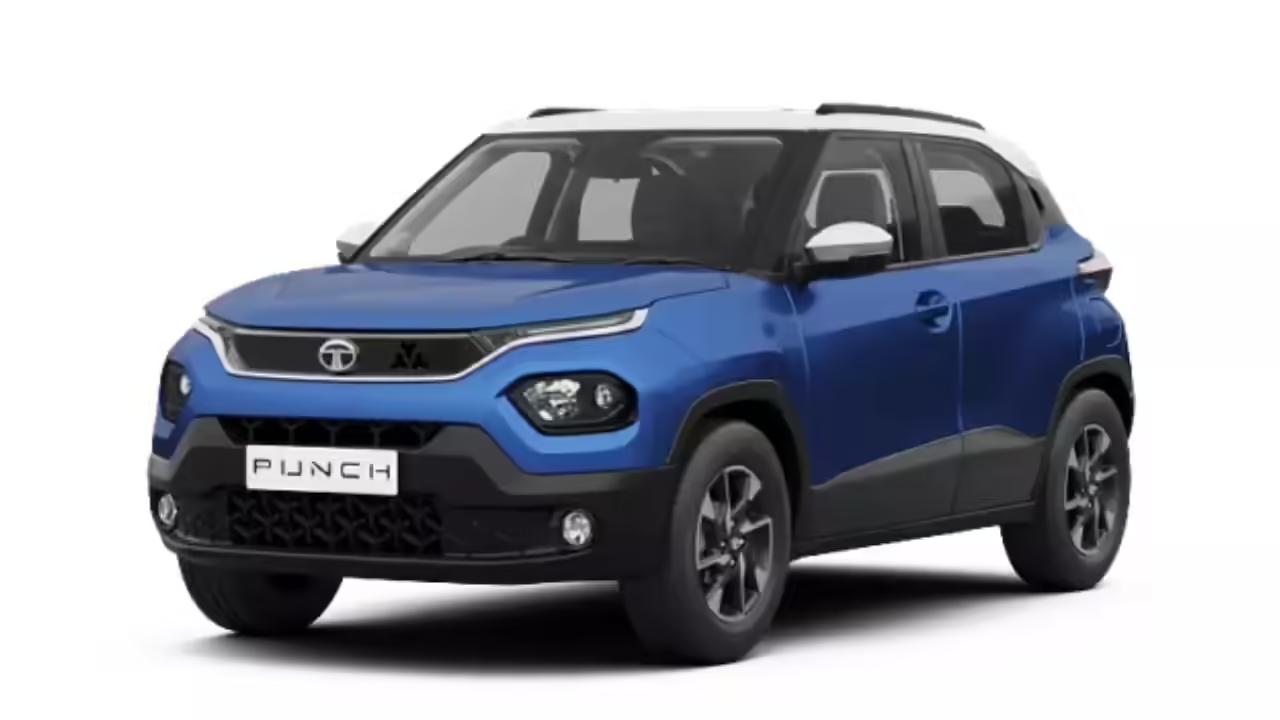
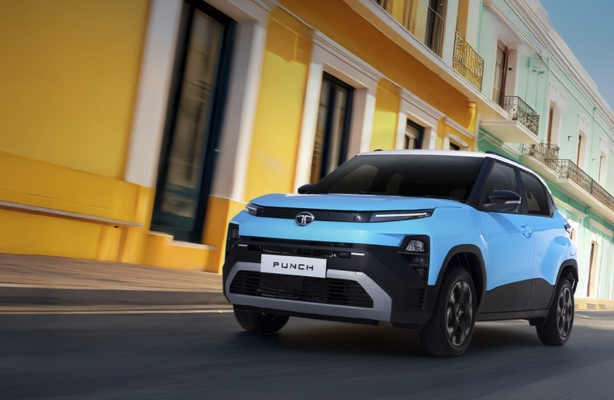
Think about the last time you stood at a local tapri, sipping cutting chai, and looked at the traffic crawling past. Chances are, you saw at least three Tata Punts in a span of five minutes. It’s not just your imagination playing tricks on you; the numbers back it up. In a stunning turn of events, this micro-SUV has grabbed the crown as India's best-selling car for June 2026, officially dethroning the usual budget hatchbacks that have ruled our roads for decades.
In a market where buyers are notoriously picky about mileage and resale value, Tata’s smallest SUV has managed to capture the collective imagination of middle-class India. It's a massive achievement for a car that started its journey as a quirky concept. We're seeing a fundamental shift in what the average Indian family wants from their first car, and Tata was quick to read the room while others were still figuring out their product strategies.
Decoding the Hype: Why Is the Punch Selling Like Hot Cakes?
Let’s face it, we Indians love an SUV stance. You get a commanding view of the road, and you don't have to scrape the underbelly of your car every time you encounter a criminally large speed breaker. Tata gave buyers exactly that, but for the price of a mid-spec Maruti Swift. With a solid 187 mm of ground clearance, this little high-rider laughs at the kind of waterlogged streets and broken tarmac that make premium sedan owners break into a cold sweat (and honestly, it shows).
Safety has also become a non-negotiable buying factor for the modern Indian family. This isn't the early 2000s anymore where people only cared about 'kitna deti hai'. With its 5-star Global NCAP safety rating, the Punch gives buyers peace of mind that their hard-earned money is protecting their family. When you combine that tough, muscular design with a tank-like build quality, it’s easy to see why buyers are skipping traditional hatchbacks altogether.
Navigating the Variant Maze: Which One Makes Sense?
Navigating the trim levels of this micro-SUV can feel like trying to solve a Rubik's cube because Tata offers a mind-boggling array of options. You have the entry-level Pure, the mid-spec Adventure, the feature-rich Accomplished, and the top-of-the-line Creative. On top of that, you have to choose between a manual gearbox, a lazy AMT automatic, and the highly practical twin-cylinder iCNG technology that doesn't eat up your entire boot space.
If you are on a tight budget, the Accomplished trim strikes the absolute sweet spot for value. It packs in most of the modern creature comforts you actually need daily, like a touchscreen infotainment system, steering-mounted controls, and a reverse parking camera, without forcing you to pay for the expensive aesthetic upgrades of the Creative trim. For the city slickers who hate heavy clutch pedals in bumper-to-bumper traffic, the AMT is convenient, but you'll have to live with that typical head-nodding sensation during quick gear shifts.
Specs At A Glance
Parameter | Details / Specifications |
|---|---|
Engine Option | 1.2-litre, 3-cylinder Revotron Petrol / iCNG |
Power (Petrol) | 86 PS @ 6000 rpm |
Torque (Petrol) | 113 Nm @ 3300 rpm |
Transmission Options | 5-speed Manual / 5-speed AMT (Petrol only) |
Ground Clearance | 187 mm |
Boot Space | 366 litres (Petrol) / 210 litres (iCNG) |
Safety Rating | 5-Star GNCAP (Adult Protection) |
How Does It Stack Up Against The Competition?
When we look at the immediate rivals, the Hyundai Exter stands out as the most direct threat. The Exter is packed to the gills with modern technology, offering a smoother four-cylinder engine and a sunroof even in its mid-spec variants. However, the Exter looks more like a tall-boy hatchback trying hard to be an SUV, whereas the Punch has that authentic, muscular mini-Harrier look that Indian buyers find irresistible.
Comparing this to traditional hatchbacks like the Maruti Swift or Baleno reveals why the sales charts have flipped. While those hatchbacks offer slightly better fuel efficiency and punchier engines, they simply can't match the road presence, cabin entry-height, and rough-road capability of the Punch. Tata has successfully convinced buyers that they can have the best of both worlds: hatchback dimensions for easy city parking, and SUV confidence for weekend road trips.
The Good And The Not-So-Good
What We Like
- Commanding seating position with excellent visibility all around
- Outstanding 5-star safety package that builds immense confidence
- Clever twin-cylinder CNG packaging that preserves usable boot space
- Robust suspension setup that glides over potholes effortlessly
What Could Be Better
- Three-cylinder petrol engine feels noisy and lacks refinement at high revs
- AMT gearbox is sluggish and hesitates during quick overtaking maneuvers
- Cabin fit and finish in some lower-spec trims could be much better
Price & When You Can Buy It
Pricing for the Tata Punch remains its biggest weapon. It generally starts in the range of ₹6.13 lakh for the bare-bones base variant and goes up to ₹10.20 lakh (ex-showroom) for the loaded Creative flagship trims. Because of this massive demand spike in June 2026, waiting periods have crept up in major metro cities, often stretching from four to eight weeks depending on the color and transmission choice you make.
Our Verdict
Here's the thing — the Tata Punch is far from a perfect automobile. Its engine can feel buzzy when you push it hard on the highway, and the AMT automatic is definitely not meant for enthusiastic driving. But as an overall package for the average Indian family looking for safety, style, and everyday usability, nothing else on the market right now comes close to offering this much value. In my opinion, it fully deserves its crown as India's favorite car, and it's going to take a monumental effort from the competition to knock it off its high perch.