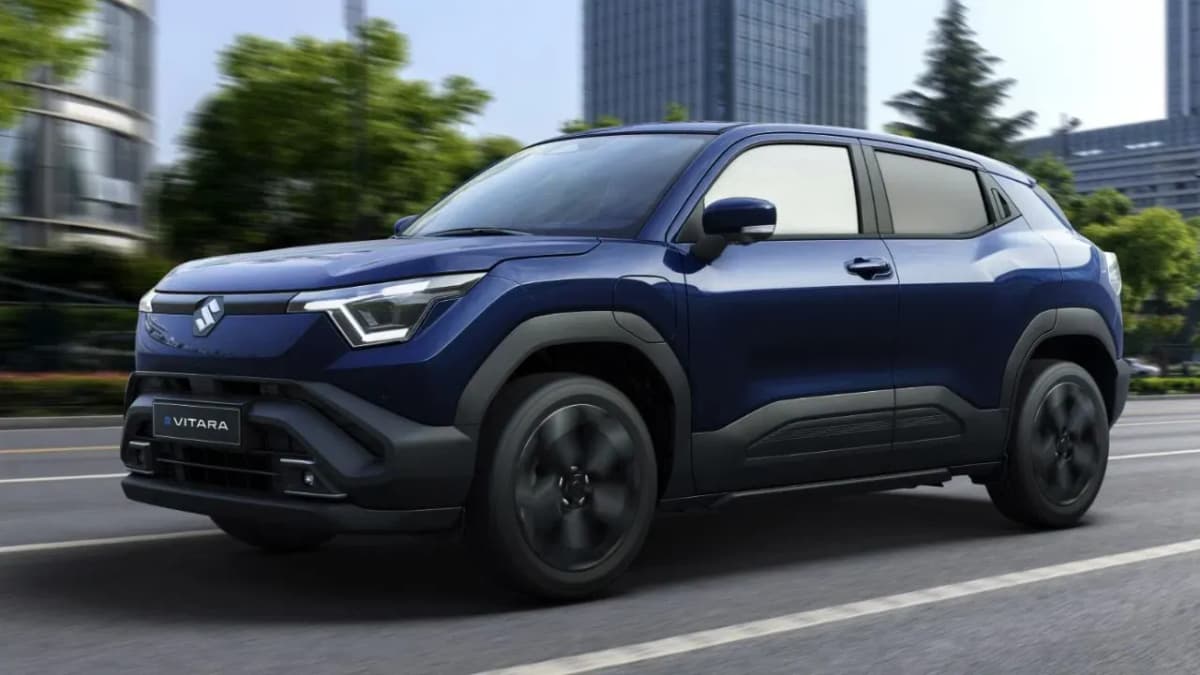
Electric cars are no longer a niche in India, and Maruti Suzuki is now ready to make its long-awaited entry into the segment. The result is the eVitara, the brand’s first fully electric SUV, positioned right in the heart of the fast-growing midsize EV space. It takes on established and upcoming rivals such as the MG ZS EV, Tata Curvv EV, Hyundai Creta Electric and Mahindra’s new-generation EVs.
We spent a full day driving the eVitara around Delhi to understand what Maruti’s first EV brings to the table—and where it still plays safe.
Design: Clean, Modern, But Not Flashy
The eVitara doesn’t try to shock you with radical styling. Instead, it follows a clean, globally inspired design that looks modern without being polarising. Its proportions are slightly more compact than some rivals, which may matter to buyers who prioritise a “big SUV” feel.
Key exterior highlights include:
Distinctive LED DRLs and tail-lamps
Chunky body cladding for a rugged look
Aerodynamic 18-inch alloy wheels
Flush-mounted charging port on the front fender
One notable design compromise is the thick C-pillar, which impacts rear visibility and creates a noticeable blind spot. The fixed glass roof helps maximise headroom, but the manually operated sunshade feels old-school in an otherwise tech-forward EV.
Cabin & Tech: European Vibe, Mixed Execution
Step inside and the eVitara immediately feels different from typical Maruti interiors. The layout has a European flavour, with good material quality and solid fit-and-finish. Some soft-touch elements are present, and everything feels built to last.
Highlights inside the cabin include:
Powered driver’s seat with lumbar and thigh support
New two-spoke steering wheel
Floating centre console with rotary drive selector
Wireless Android Auto and Apple CarPlay
That said, the execution isn’t flawless. The twin-screen layout—one for infotainment and one for the instrument cluster—feels oddly misaligned. The infotainment system is feature-rich but not the quickest to respond, and some menus suffer from noticeable lag. Physical buttons are limited, which means you’ll spend more time interacting with the touchscreen than you might like.
Space & Practicality: Not Its Strongest Suit
Interior space is where the eVitara starts to show its global-market roots. The raised floor (due to the battery pack) results in a knees-up seating position, especially noticeable for taller drivers and rear passengers.
Key observations:
Front headroom is acceptable, rear headroom is tight for taller occupants
Rear doors don’t open wide, making ingress and egress awkward
Rear bench is split 40:20:40, which adds flexibility
Boot space feels average for the segment, even with sliding rear seats
One welcome surprise is the full-size spare wheel, something many EVs skip in the name of weight savings.
Performance & Ride: Calm, Confident and Comfortable
Where the eVitara redeems itself is on the road. The electric motor delivers strong, smooth acceleration, making city driving effortless and highway cruising stress-free. Expect real-world efficiency of around 6.5–7 km/kWh, translating to roughly 400 km of usable range.
Driving impressions:
Quick off the line, with 0–100 km/h in around 8 seconds
Light steering suited for city use
Comfortable ride quality thanks to independent rear suspension
Body roll is present but well controlled
It’s not an enthusiast’s EV, but it’s tuned exactly how most buyers will want—easygoing, predictable and comfortable.
Safety: A Strong Card
Safety is one area where the eVitara clearly stands out. It comes loaded with:
Seven airbags (including a knee airbag)
ADAS with well-calibrated interventions
All-wheel disc brakes
A 5-star Bharat NCAP rating
The 360-degree camera works well, though the automatic view transitions may not be to everyone’s taste.
Should You Consider the Maruti Suzuki eVitara?
The eVitara doesn’t aim to be the most exciting or the most feature-packed EV in its class. Instead, it focuses on ease of ownership, safety and trust—areas where Maruti has traditionally excelled.
Its biggest trump card could be Maruti Suzuki’s plan to roll out a large fast-charging network across India, leveraging its vast dealer and service footprint. Add to that the proposed Battery-as-a-Service (BaaS) pricing model, and the eVitara could become far more accessible than it initially appears.
Final Verdict
The eVitara may not set new benchmarks in design or cabin space, but it delivers a well-rounded, dependable EV experience. If pricing is aggressive and the charging infrastructure promise materialises, Maruti Suzuki’s first electric SUV could quietly become one of the most practical EV choices in India.