What's The Big News?
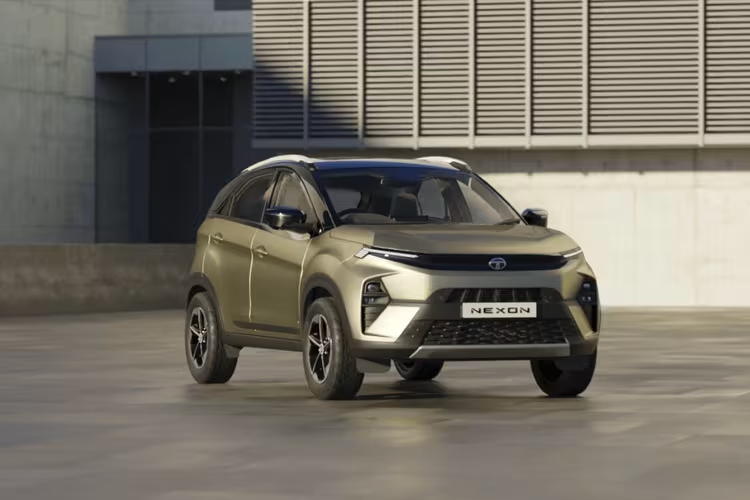
Alright, folks, Arman here, fresh off some chatter that’s got the whole industry buzzing. It seems Tata Motors isn't just sitting pretty with the current Nexon's success. We’re hearing whispers, strong ones at that, that the next-generation Nexon is slated for a launch around 2027. Now, that might sound like a long way off, but here’s the kicker: it’s expected to hit the streets *before* Tata's much-hyped, pure-EV Avinya series.
This isn't just a minor refresh we're talking about; this is a full-blown generational leap for India's best-selling compact SUV. Think about it: a brand-new Nexon, designed from the ground up, landing well before the Avinya's pure-electric platform makes its debut. This timing tells us a lot about Tata’s strategy and, more importantly, what we, the buyers, can actually expect from the car that many of us save up for years to bring home.
The 2027 Timeline & What It Means for Nexon's Core
Let's dive right into that "before Avinya" bit, because honestly, it’s the most intriguing part. The Avinya platform is a dedicated 'Born Electric' architecture, meant only for EVs. If the next-gen Nexon is coming before it, it strongly suggests that this new Nexon isn't going to be a pure-EV only vehicle. No, sir. It's highly probable we'll see an evolution of Tata's current, very flexible X1 platform – maybe something like an ALFA 2.0 – that can comfortably house petrol, diesel (yes, really, don't write it off yet!), and electric powertrains.
This multi-energy approach is a smart move for the Indian market. Not everyone’s ready to jump onto the EV bandwagon completely, and a platform that can cater to all types of fuel means wider appeal and better accessibility. It shows Tata isn't just chasing the future; they’re building bridges to it, ensuring their most popular model remains relevant for every kind of buyer, whether you're looking for that punchy turbo-petrol or the silent shove of an electric motor. It’s a pragmatic strategy, and one that resonates deeply with how Indian families buy cars.
Design Language & Cabin Revolution
Now, while exact design details are under wraps, we can make some educated guesses based on Tata's recent concepts like the Curvv and sierra-ev">Sierra EV. Expect the next-gen Nexon to push the boundaries of Tata’s "Impact 2.0" design philosophy even further. We're talking sharper lines, more aerodynamic profiles, and possibly a coupe-SUV silhouette that’s been teased with the Curvv concept. It won't just be an evolution; it'll be a transformation, making the current model look a bit dated, no doubt.
Inside, the cabin is where Tata has been consistently raising the bar. For 2027, expect a revolution. Large, floating touchscreens will be a given, along with fully digital instrument clusters. Materials quality will likely see a significant upgrade, aiming for a more premium feel, maybe even better than what Maruti gives you at this price point. We're also anticipating a suite of advanced driver-assistance systems (ADAS) – adaptive cruise control, lane-keeping assist, and emergency braking – which are rapidly becoming standard in the segment, especially at that projected price range.
Specs At A Glance
Feature | Details (Expected/TBA) |
|---|---|
Launch Timeline | 2027 (Expected, before Avinya series) |
Platform | Evolved X1/ALFA Architecture (Likely) |
Powertrains | Petrol, Diesel, Electric (Expected) |
Design Philosophy | Advanced Impact 2.0 (Likely influenced by Curvv/Sierra concepts) |
Infotainment | Large floating touchscreen (Expected) |
Instrument Cluster | Full Digital (Expected) |
Safety Features | ADAS Suite (Expected) |
Battery Tech (EV) | Improved range & charging (Expected) |
How Does It Stack Up Against The Competition?
When the next-gen Nexon arrives in 2027, it won’t be alone. Rivals like the Maruti Brezza, Hyundai Venue, and Kia Sonet will also have evolved, perhaps even seen their own generational updates. Tata’s unique selling proposition will continue to be its multi-energy option, offering buyers a choice that most rivals can't match across the same model line. Maruti might have strong hybrids, and Hyundai-Kia good turbos, but a fully integrated ICE-EV strategy within one nameplate gives Tata an edge.
Furthermore, Tata's unwavering focus on safety, which has seen the current Nexon achieve a 5-star GNCAP rating, will undoubtedly carry forward. This commitment, combined with the expected new features and refined driving dynamics, should ensure the Nexon remains a formidable challenger. It won't just be competing on price; it'll be competing on value, choice, and peace of mind – factors that resonate deeply with Indian car buyers.
The Good And The Not-So-Good
What We Like
- Early launch before the Avinya series, suggesting a focus on multi-energy options.
- Potential for a truly revolutionary design, drawing from recent Tata concepts.
- Expected significant upgrades in interior quality and technology, including ADAS.
- Continued focus on safety, a major selling point for Indian families.
- Maintains relevance for a wider audience not ready for pure EV-only platforms.
What Could Be Better
- 2027 is still a few years away; details are very scarce right now.
- The "newness" might feel diluted if it's still on an evolved version of the current platform rather than a completely fresh sheet.
- Pricing will inevitably climb, potentially pushing it out of reach for some current Nexon buyers.
- Will Tata ensure consistent build quality and service experience with so much new tech?
Price & When You Can Buy It
As confirmed by the whispers, the next-gen Tata Nexon is expected to launch sometime in 2027. Exact dates are, of course, a closely guarded secret right now. As for pricing, we’re talking about a car that’s still years away. It's impossible to give precise figures, but expect a substantial hike over the current model. The segment itself will have evolved, and with all the advanced tech, new platform, and upgraded interiors, it’s safe to say it won't be for the price of a mid-spec Swift anymore. Pricing will be announced closer to launch, naturally, but prepare for it to be competitive within its updated and likely more premium segment.
Our Verdict
Look, the next-gen Tata Nexon arriving in 2027, ahead of the Avinya, is a massive statement from Tata Motors. It tells us they're not just resting on their laurels; they're actively planning for a diverse future, catering to both EV enthusiasts and those who still prefer traditional powertrains. This car has been a game-changer for Tata, and its successor needs to be even more so to maintain its dominance. While the wait is long and specifics are few, the direction seems promising. Honestly, if Tata delivers on the promise of advanced design, top-tier features, and that unwavering safety commitment, this next-gen Nexon could very well redefine the compact SUV segment all over again. It’s a lot of pressure, but if anyone can pull it off in India, it’s Tata.