In this report
- EV vs CNG vs Petrol: A Compact SUV Cost Comparison
- Our Contenders and Core Assumptions for This 2026 Analysis
- Step 1: The Upfront Cost
- Step 2: The Running Cost Battle (Per Kilometre)
- Step 3: Calculating the 5-Year Total Cost
- What the Numbers Mean
- Your Personalised Recommendation: Which SUV Should You Buy?
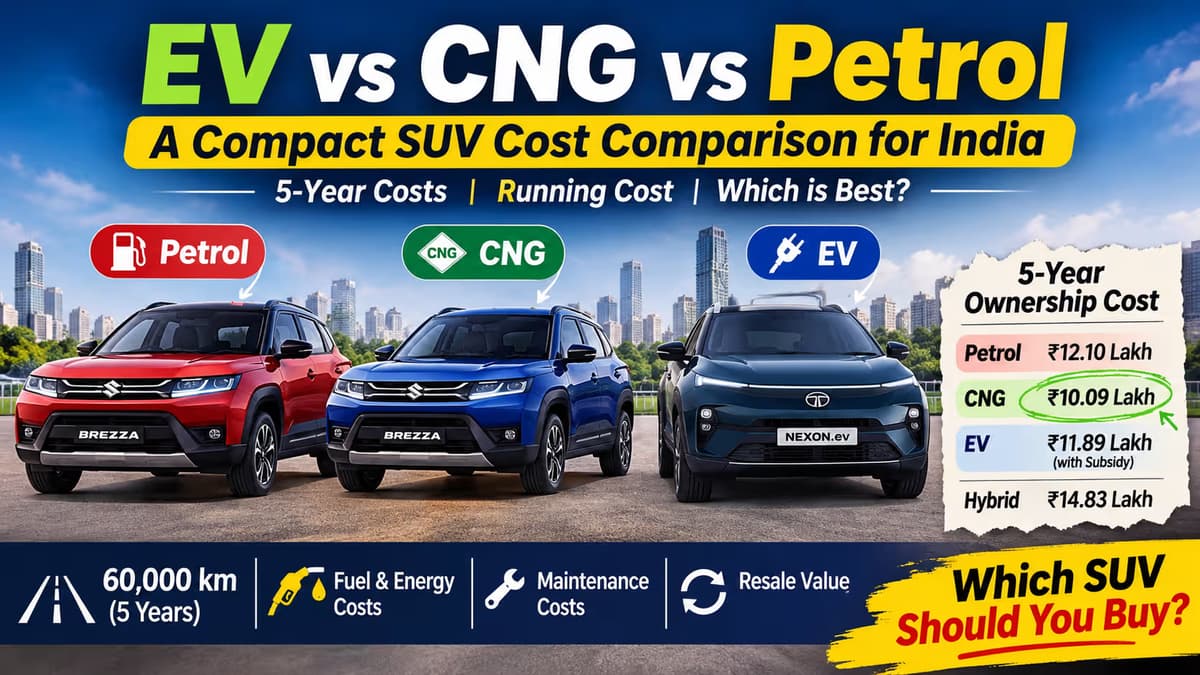
EV vs CNG vs Petrol: A Compact SUV Cost Comparison
An illustrative calculation for an owner driving an assumed 1,000 km per month shows how different powertrains can affect long-term costs. A traditional petrol SUV may be a suitable choice for those with very low annual mileage.
This article breaks down the five-year cost of owning this type of car in India, based on an illustrative model. We go beyond the sticker price to analyse estimated fuel expenses, maintenance, and resale value to compare the potential costs of petrol, CNG, and EV powertrains.
Our Contenders and Core Assumptions for This 2026 Analysis
To provide a realistic comparison, we've selected popular models representing each fuel type and established a clear set of illustrative assumptions. It’s important to note that comprehensive 5-year maintenance schedules, insurance premiums, or projected resale values were not available, so we have used estimates for these figures. All calculations are based on prices in Mumbai as of November 2026.
- Petrol: Maruti Suzuki Brezza (Petrol)
- CNG: Maruti Suzuki Brezza (CNG)
- Strong Hybrid: Maruti Suzuki Grand Vitara (Hybrid)
- EV: Tata Nexon EV (30 kWh battery)
Models mentioned above

Maruti Suzuki
Brezza
Ex-showroom₹7.40 Lakh – ₹13.09 Lakh
- Fuel
- Petrol, CNG
- Mileage
- 20.17 to 20.95 kmpl
- Engine
- 1462 cc & 998 cc
- Safety
- 5 Star (Bharat NCAP)

Maruti Suzuki
Grand Vitara
Ex-showroom₹10.77 Lakh – ₹20.22 Lakh
- Fuel
- Petrol, CNG, Hybrid
- Mileage
- 27.97 kmpl
- Engine
- 1462 cc & 1490 cc
- Transmission
- Manual / Automatic

Tata
Nexon EV
Ex-showroom₹12.49 Lakh – ₹17.49 Lakh
- Fuel
- Electric
- Driving Range
- 325 to 489 km
- Safety
- 5 Star (Bharat NCAP)
- Transmission
- Automatic
Key Assumptions for our 5-Year Illustrative Cost Model:
- Total Distance: An assumed 60,000 km (12,000 km per year).
- Fuel & Energy Prices: Petrol at ₹111.21/litre, CNG at ₹91.50/kg. For the EV, we assume a blended electricity rate of ₹10.40/kWh, based on an illustrative scenario of 80% home charging at an estimated ₹8/kWh and 20% public charging at an estimated ₹20/kWh.
- Assumed Real-World Efficiency:
- Petrol Brezza: An assumed 15 kmpl, an illustrative midpoint of the 12 to 18 kmpl range reported by ZigWheels.
- CNG Brezza: 21 km/kg, an illustrative midpoint of the 20-22 km/kg range for mixed driving reported by Vedanshauto.
- Hybrid Grand Vitara: An estimated 24 kmpl, based on the Grand Vitara Hybrid's ARAI-certified mileage of 27.97 kmpl.
- Tata Nexon EV: An assumed efficiency of 0.128 kWh/km, calculated from its real-world range of 234 km on a 30 kWh battery, a figure reported by Meraev.
Step 1: The Upfront Cost
To illustrate the cost comparison, we have used assumed on-road prices for comparable variants in 2026. Buyers of the Tata Nexon EV in Maharashtra can reduce this cost by up to ₹25,000 if they scrap an ICE vehicle older than 15 years.
Fuel Type | Model (Variant) | Assumed On-Road Price (Mumbai) |
|---|---|---|
Petrol | Maruti Suzuki Brezza | ₹14,50,000 |
CNG | Maruti Suzuki Brezza CNG | ₹15,50,000 |
Strong Hybrid | Maruti Suzuki Grand Vitara | ₹21,00,000 |
EV | Tata Nexon EV | ₹18,50,000 |
Note: These prices are assumed for this illustrative calculation.
Step 2: The Running Cost Battle (Per Kilometre)
This is where the powertrain technologies diverge in our model. Using the assumed fuel prices and efficiencies, we can calculate the cost to run each car for a single kilometre. In this calculation, the EV's advantage is immediately obvious.
Fuel Type | Calculation | Running Cost per km |
|---|---|---|
Petrol | ₹111.21 / 15 kmpl | ₹7.41 |
CNG | ₹91.50 / 21 km/kg | ₹4.36 |
Strong Hybrid | ₹111.21 / 24 kmpl | ₹4.63 |
EV | 0.128 kWh/km * ₹10.40/kWh | ₹1.33 |
Step 3: Calculating the 5-Year Total Cost
For this calculation, we've added estimated 5-year maintenance costs and projected depreciation.
Our Illustrative Formula: (On-Road Price) + (5-Year Fuel Cost) + (5-Year Estimated Maintenance) - (5-Year Resale Value)
Cost Component | Petrol (Brezza) | CNG (Brezza) | Strong Hybrid (Grand Vitara) | EV (Nexon EV) |
|---|---|---|---|---|
Assumed On-Road Price | ₹14,50,000 | ₹15,50,000 | ₹21,00,000 | ₹18,50,000 |
5-Year Fuel/Energy Cost (60,000 km) | ₹4,44,600 | ₹2,61,600 | ₹2,77,800 | ₹79,800 |
5-Year Est. Maintenance | ₹40,000 | ₹50,000 | ₹50,000 | ₹25,000 |
Sub-Total Cost | ₹19,34,600 | ₹18,61,600 | ₹24,27,800 | ₹19,54,800 |
Est. 5-Yr Depreciation | ₹7,25,000 (50%) | ₹6,97,500 (45%) | ₹11,55,000 (55%) | ₹11,10,000 (60%) |
Less: Est. Resale Value (after 5 yrs) | ₹7,25,000 | ₹8,52,500 | ₹9,45,000 | ₹7,40,000 |
Net Ownership Cost (5 Years) | ₹12,09,600 | ₹10,09,100 | ₹14,82,800 | ₹12,14,800 |
Net Cost (EV with Subsidy) | - | - | - | ₹11,89,800 |
Effective Cost per km | ₹20.16 | ₹16.82 | ₹24.71 | ₹19.83 (with subsidy) |
What the Numbers Mean
The results of this specific calculation show a range of outcomes over the 5-year, 60,000 km period. In our model, the CNG car's total calculated cost is ₹10,09,100. The EV with the scrappage bonus applied has a calculated cost of ₹11,89,800. The strong hybrid's calculated cost is ₹14,82,800 in this scenario, influenced by its assumed high purchase price which was not fully offset by fuel savings compared to the CNG option in this model.
Your Personalised Recommendation: Which SUV Should You Buy?
- For the High-Mileage Driver (e.g., over 20,000 km/year): An EV could be a consideration due to its low running costs. The Tata Nexon EV also has a 5-Star Bharat NCAP safety rating.
- For the Highway Cruiser with Mixed Usage: A Strong Hybrid could be considered for its high fuel efficiency.
- For the Low-Mileage Urban User (e.g., under 10,000 km/year): A Petrol model could be suitable, particularly for those who drive less.
Note: Figures in this article are based on manufacturer information, official certifications and independent tests available at the time of writing. Prices, specifications and real-world mileage can vary by variant, city, riding or driving style and over time. Please confirm the latest details with the manufacturer or an authorised dealer, and seek expert advice before making a purchase decision.
Models in this report
3 models
Maruti Suzuki
Brezza
Ex-showroom₹7.40 Lakh – ₹13.09 Lakh
- Fuel
- Petrol, CNG
- Mileage
- 20.17 to 20.95 kmpl
- Engine
- 1462 cc & 998 cc
- Safety
- 5 Star (Bharat NCAP)
Maruti Suzuki
Grand Vitara
Ex-showroom₹10.77 Lakh – ₹20.22 Lakh
- Fuel
- Petrol, CNG, Hybrid
- Mileage
- 27.97 kmpl
- Engine
- 1462 cc & 1490 cc
- Transmission
- Manual / Automatic
Tata
Nexon EV
Ex-showroom₹12.49 Lakh – ₹17.49 Lakh
- Fuel
- Electric
- Driving Range
- 325 to 489 km
- Safety
- 5 Star (Bharat NCAP)
- Transmission
- Automatic
Frequently asked questions
How does an EV's ownership cost compare to a petrol SUV over 5 years?
In our 5-year cost comparison for an assumed usage, the EV's calculated total ownership cost (including a scrappage bonus) was ₹11,89,800, while the petrol SUV's was ₹12,09,600. In this model, the EV's significant savings on energy costs are nearly balanced by its higher assumed initial price and a higher estimated depreciation rate.
What is the real-world range of the Tata Nexon EV?
According to a real-world range estimate by Meraev for the Tata Nexon EV with a 30 kWh battery, city driving yields around 245 km, while consistent highway driving at 80 km/h yields about 215 km. The same report estimates a mixed-use range of approximately 234 km.
Does the government offer subsidies for EVs in 2026?
In Maharashtra, as of November 2026, EV buyers are eligible for a scrappage bonus of up to ₹25,000 if they scrap an internal combustion engine (ICE) vehicle that is older than 15 years.

Researched & written by
Abhinav SrivastavSenior Automotive Journalist & Editor
Abhinav Srivastav is a Senior Automotive Journalist with over 8 years of experience covering the Indian automobile industry. He specialises in car reviews, EV technology, and in-depth market analysis. Before joining CarBikeGPT, he contributed to leading automotive publications and test-drove over 200 vehicles across segments. His expertise spans petrol, diesel, hybrid, and electric powertrains, with a particular focus on value-for-money buying decisions for Indian consumers.