In this report
- Strong Hybrid vs Turbo Petrol: A Verdict for Buyers
- Fuel Efficiency: Where the Real Savings Are
- Running Cost Analysis: The Rupee-per-Kilometre Breakdown
- Performance and Driveability: Smooth Operator vs. Punchy Performer
- Total Cost of Ownership: The Upfront Premium vs. Long-Term Savings
- Our Recommendation: Which Powertrain Wins for You?
Strong Hybrid vs Turbo Petrol: A Verdict for Buyers
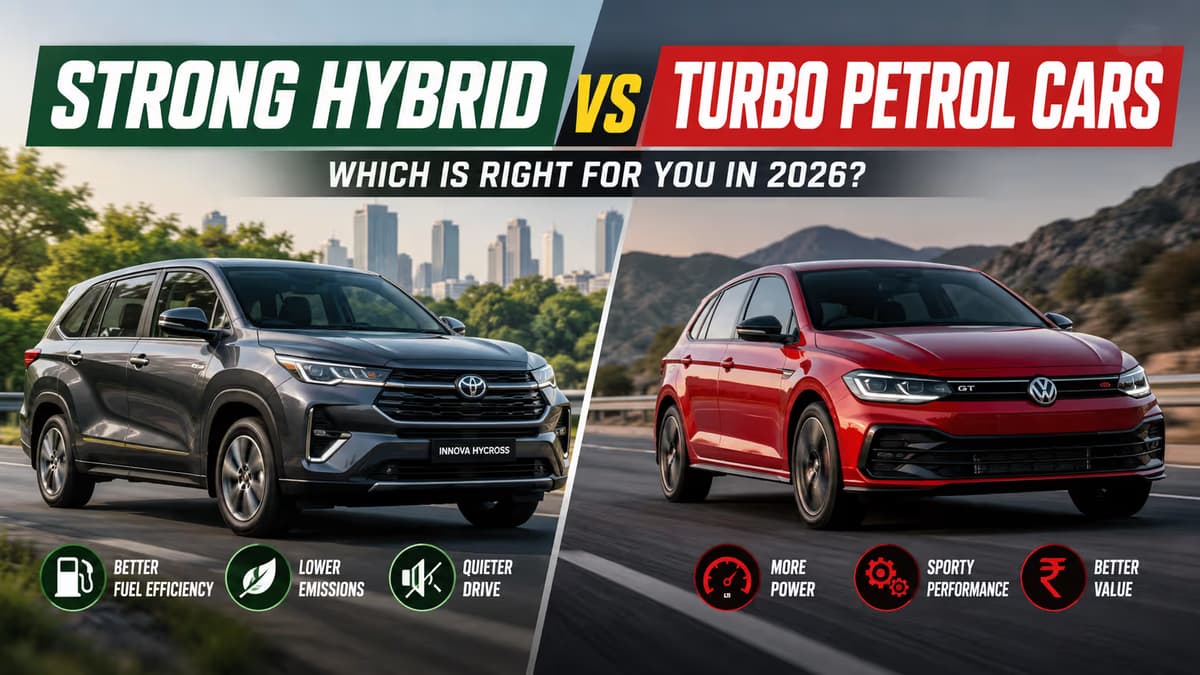
For buyers with heavy city usage, a strong hybrid can offer significant fuel efficiency and low running costs. However, for those who prioritize driving pleasure and have more highway runs, a turbo petrol may offer a compelling balance of performance and a lower initial price.
The car market offers these two distinct petrol powertrain technologies, but navigating the marketing jargon can be tough. Let's break down what each technology means for your wallet and your driving experience.
Fuel Efficiency: Where the Real Savings Are
This is where the differences become apparent, especially when comparing official ARAI figures to real-world performance. Strong hybrids tend to perform very efficiently in stop-and-go traffic, conditions where traditional petrol engines are often less efficient.
The Honda City e:HEV Strong Hybrid demonstrates this perfectly. In road tests, its real-world city mileage is approximately 25.25 kmpl, and its highway mileage is 24.22 kmpl.
In contrast, the Hyundai Verna 1.5L Turbo-Petrol DCT has an ARAI-certified mileage of 20.6 kmpl. A road test recorded its real-world mileage at 13.5 kmpl.
Model | Powertrain Type | ARAI-Certified Mileage (kmpl) | Real-World Mileage (kmpl) |
|---|---|---|---|
Maruti Grand Vitara / Toyota Hyryder | Strong Hybrid | 27.97 | Typically 22 to 25 |
Honda City e:HEV | Strong Hybrid | N/A | 25.25 (City), 24.22 (Highway) |
Hyundai Verna 1.5L Turbo DCT | N/A | 20.6 | 13.5 (in a road test) |
Running Cost Analysis: The Rupee-per-Kilometre Breakdown
Let's translate that mileage into actual running costs. Assuming the petrol price in Delhi at ₹102.12 per litre, the difference is substantial. For this illustrative calculation, we compare the real-world mileage figures recorded for both the Honda City e:HEV (city) and the Hyundai Verna.
Here’s the cost to drive one kilometre based on these road tests:
- Honda City e:HEV (Strong Hybrid, City): ₹4.04 per km
- Hyundai Verna Turbo (Turbo Petrol, Real-World): ₹7.56 per km
Assuming an illustrative monthly running of 1,000 km, your fuel bill would look like this:
- Honda City e:HEV: ₹4,040
- Hyundai Verna Turbo: ₹7,560
A strong hybrid user could save approximately ₹3,520 per month in fuel costs compared to a turbo petrol driver based on these figures. This saving can help offset the purchase price of a hybrid car. If you are considering a hybrid for your daily 100km commute, check out our guide on the Grand Vitara Hybrid vs an EV.
Performance and Driveability: Smooth Operator vs. Punchy Performer
Money isn't everything; how a car feels to drive is just as important.
Strong Hybrids: The Honda City e:HEV, for instance, has an electric motor that delivers an official 253 Nm of torque. The transition between electric and petrol power is smooth.
Total Cost of Ownership: The Upfront Premium vs. Long-Term Savings
This is the final piece of the puzzle. You must weigh any initial price premium against the running cost savings. Using our earlier calculation, a strong hybrid saves ₹3,520 per month over a turbo petrol based on these specific figures. If we assume an illustrative price premium for the hybrid is ₹3,00,000, it would take about 85 months (or about 7.1 years) of 1,000 km/month driving to break even on fuel savings alone. This is why hybrids for low running might not make financial sense.
According to estimates, the 5-year scheduled service bill for a strong hybrid is approximately ₹7,000 to ₹8,000 more than a mild hybrid. A major service could cost an estimated extra ₹2,500 to ₹4,000, partly due to a secondary cooling loop for the power electronics.
Our Recommendation: Which Powertrain Wins for You?
The choice depends on your priorities and driving patterns.
Go for a Strong Hybrid if:
- Your daily drive is primarily in city traffic.
- Your monthly running is high (above 1,200-1,500 km).
- You prioritize low running costs and a smooth, quiet driving experience.
- You plan to keep the car for 5-7 years or more to recover the initial cost. For a deeper look at options, see our guide to strong hybrid cars in India under 50 lakh.
Go for a Turbo Petrol if:
- You enjoy an engaging and performance-oriented drive.
- Your usage is a mix of city and frequent highway trips.
- Your monthly running is moderate (less than 1,000 km), where fuel savings from a hybrid are less impactful.
- You want strong performance without paying the full premium for a strong hybrid.
Note: Figures in this article are based on manufacturer information, official certifications and independent tests available at the time of writing. Prices, specifications and real-world mileage can vary by variant, city, riding or driving style and over time. Please confirm the latest details with the manufacturer or an authorised dealer, and seek expert advice before making a purchase decision.
Models in this report
3 models

Honda
City
Ex-showroom₹12.04 Lakh – ₹21.04 Lakh
- Fuel
- Petrol, Hybrid
- Mileage
- 17.77 to 27.26 kmpl
- Engine
- 1498 cc
- Transmission
- Manual / Automatic

Hyundai
Verna
Ex-showroom₹10.98 Lakh – ₹18.40 Lakh
- Fuel
- Petrol
- Engine
- 1482 cc & 1497 cc
- Transmission
- Manual / Automatic
- Seating Capacity
- 5

Maruti Suzuki
Grand Vitara
Ex-showroom₹10.77 Lakh – ₹20.22 Lakh
- Fuel
- Petrol, CNG, Hybrid
- Mileage
- 27.97 kmpl
- Engine
- 1462 cc & 1490 cc
- Transmission
- Manual / Automatic
Frequently asked questions
Which is more fuel-efficient, strong hybrid or turbo petrol?
Strong hybrids are generally more fuel-efficient, especially in city traffic. For example, the Honda City e:HEV offers a real-world city mileage of 25.25 kmpl. In contrast, a turbo petrol car like the Hyundai Verna Turbo DCT has an ARAI-certified mileage of 20.6 kmpl, while one road test recorded its real-world mileage at 13.5 kmpl.
Do turbo petrol cars give good mileage in the city?
Mileage varies by model and driving conditions. For example, the Hyundai Verna 1.5L Turbo-Petrol DCT has an ARAI-certified mileage of 20.6 kmpl, while one road test recorded its real-world mileage at 13.5 kmpl.

Researched & written by
Abhinav SrivastavSenior Automotive Journalist & Editor
Abhinav Srivastav is a Senior Automotive Journalist with over 8 years of experience covering the Indian automobile industry. He specialises in car reviews, EV technology, and in-depth market analysis. Before joining CarBikeGPT, he contributed to leading automotive publications and test-drove over 200 vehicles across segments. His expertise spans petrol, diesel, hybrid, and electric powertrains, with a particular focus on value-for-money buying decisions for Indian consumers.