In this report
Beyond the Stars: Making Sense of Bharat NCAP in 2026
As an Indian car buyer in October 2026, you should look beyond the simple 1-to-5 star rating from Bharat NCAP. The real story is in the detailed scores for Adult Occupant Protection (AOP) and Child Occupant Protection (COP). A higher score within the same star rating signifies better protection in a crash. Understanding these numbers is key to choosing a genuinely safer car for your family.
Launched officially on August 22, 2023, and operational since October 1, 2023, the Bharat New Car Assessment Program (BNCAP) has fundamentally shifted the conversation around vehicle safety in India. It is the world's 10th NCAP and applies to M1 category vehicles, which means most passenger cars with up to eight seats and a gross weight under 3,500 kg.
How Current Bharat NCAP (AIS-197) Ratings Work
The current BNCAP framework, officially known as AIS-197, will be valid until September 30, 2027. It evaluates a car's structural integrity and restraint systems through a series of controlled crashes. A vehicle is assigned a star rating from 1 to 5, with 5 stars representing the highest safety level.
The evaluation is based on performance in three specific crash tests:
- Frontal Offset Impact Test: Conducted at 64 km/h, this simulates a head-on collision where only a portion of the car's front hits a barrier.
- Side Impact Test: A mobile barrier hits the driver's side of the car at 50 km/h, mimicking a 'T-bone' crash.
- Side Pole Impact Test: The car is propelled sideways into a rigid pole at 29 km/h, simulating a slide into a tree or post.
From these tests, two crucial scores are generated:
- Adult Occupant Protection (AOP): Scored out of a maximum of 32 points. This measures protection for the driver and front passenger.
- Child Occupant Protection (COP): Scored out of a maximum of 49 points. This assesses how well the car protects child dummies in recommended child seats.
To achieve the coveted official 5-star rating, a car must score at least 27 out of 32 points for AOP and 41 out of 49 points for COP. This is where you need to look closer. Two cars, like the Tata Nexon and Tata Harrier, could both have 5-star ratings, but one might score 28 points in AOP while another scores 31. That 3-point difference can mean a significant variation in protection. Always check the detailed score sheet on the official BNCAP website.
Models mentioned above

Tata
Nexon
Ex-showroom₹7.37 Lakh – ₹14.22 Lakh
- Fuel
- Petrol, CNG, Diesel
- Engine
- 1199 cc & 1497 cc
- Safety
- 5 Star (Bharat NCAP)
- Transmission
- Manual / Automatic

Tata
Harrier
Ex-showroom₹12.89 Lakh – ₹25.35 Lakh
- Fuel
- Petrol, Diesel
- Mileage
- 16.8 kmpl
- Engine
- 1498 cc & 1956 cc
- Safety
- 5 Star (Bharat NCAP)
The Big Shift: Bharat NCAP 2.0 Arrives in 2027
The safety landscape is set for a major evolution. Starting from October 2027, Bharat NCAP 2.0 will be implemented. This new protocol moves beyond just crash survival and adopts a more holistic, 100-point system focused on overall safety.
The new evaluation will be based on five distinct pillars, each with a specific weightage:
- Crash Protection (55%): Assesses how well the car protects occupants in a collision.
- Vulnerable Road User Protection (20%): Measures protection for pedestrians and cyclists in an impact.
- Safe Driving (10%): Evaluates features that promote safer driving habits.
- Accident Avoidance (10%): Focuses on active safety systems (like ADAS) that help prevent a crash.
- Post-Crash Safety (5%): Considers systems that aid rescue and prevent further incidents after a crash.
The number of mandatory crash tests will also increase from three to five, adding a full-width frontal impact (50 km/h), an oblique pole side impact (32 km/h), and a mobile rigid rear impact (50 km/h) to the existing tests. This comprehensive approach, developed by the Automotive Research Association of India (ARAI), aligns Indian standards more closely with global benchmarks like Euro NCAP.
Comparing Current BNCAP with the Upcoming BNCAP 2.0
The difference between the two programs is significant. Here’s a clear breakdown for buyers:
Feature | Current Bharat NCAP (AIS-197) | Bharat NCAP 2.0 (from Oct 2027) |
|---|---|---|
Rating System | 1-5 Stars (based on AOP/COP scores) | 100-point system across five pillars |
Crash Tests | Three mandatory tests | Five mandatory tests |
Primary Focus | Passive Safety (occupant protection during a crash) | Holistic Safety (passive, active, post-crash, VRU protection) |
5-Star Threshold | Min. 27/32 AOP & 41/49 COP | Min. 70 points (2027-2029), rising to 80 points (2029-2031) |
5-Star Disqualifiers | Not meeting point thresholds | Zero points in any of the five pillars or red-zone dummy injuries |
Analyst's Recommendation for Indian Car Buyers
Your car buying strategy should adapt based on when you plan to make a purchase.
If you are buying a car now or in early 2027:
- Do not rely solely on the star rating. Insist on seeing the detailed AOP and COP scores. A car with 30/32 AOP is demonstrably safer for adults than one with 27/32, even if both are rated 5-star.
- If you travel with children, the COP score is non-negotiable. Look for the highest possible score out of 49. The safety of models like the Tata Safari has been a key selling point.
- Remember that a 5-star BNCAP rating is a measure of protection in specific crash scenarios; it does not make a vehicle accident-proof. Safe driving habits are paramount.
If you are planning to buy in late 2027 or beyond:
- The game changes completely. A 5-star car under BNCAP 2.0 will be significantly more advanced in overall safety than a 5-star car of today.
- Pay close attention to the scores in the 'Accident Avoidance' and 'Vulnerable Road User Protection' pillars. This is where manufacturers will compete, leading to more cars with ADAS and pedestrian-friendly designs.
- Under the new rules, a car cannot get a 5-star rating if it shows critical 'red-zone' injuries on dummies or scores zero in any pillar. This eliminates any weak links. Waiting for a BNCAP 2.0 rating will give you a far more complete picture of a car's safety credentials.
Ultimately, Bharat NCAP has empowered buyers with crucial data. Use it wisely. Look beyond the shiny stars, dig into the points, and understand what the future holds with BNCAP 2.0 to make the safest possible choice for you and your loved ones.
Models in this report
3 models
Tata
Nexon
Ex-showroom₹7.37 Lakh – ₹14.22 Lakh
- Fuel
- Petrol, CNG, Diesel
- Engine
- 1199 cc & 1497 cc
- Safety
- 5 Star (Bharat NCAP)
- Transmission
- Manual / Automatic
Tata
Harrier
Ex-showroom₹12.89 Lakh – ₹25.35 Lakh
- Fuel
- Petrol, Diesel
- Mileage
- 16.8 kmpl
- Engine
- 1498 cc & 1956 cc
- Safety
- 5 Star (Bharat NCAP)
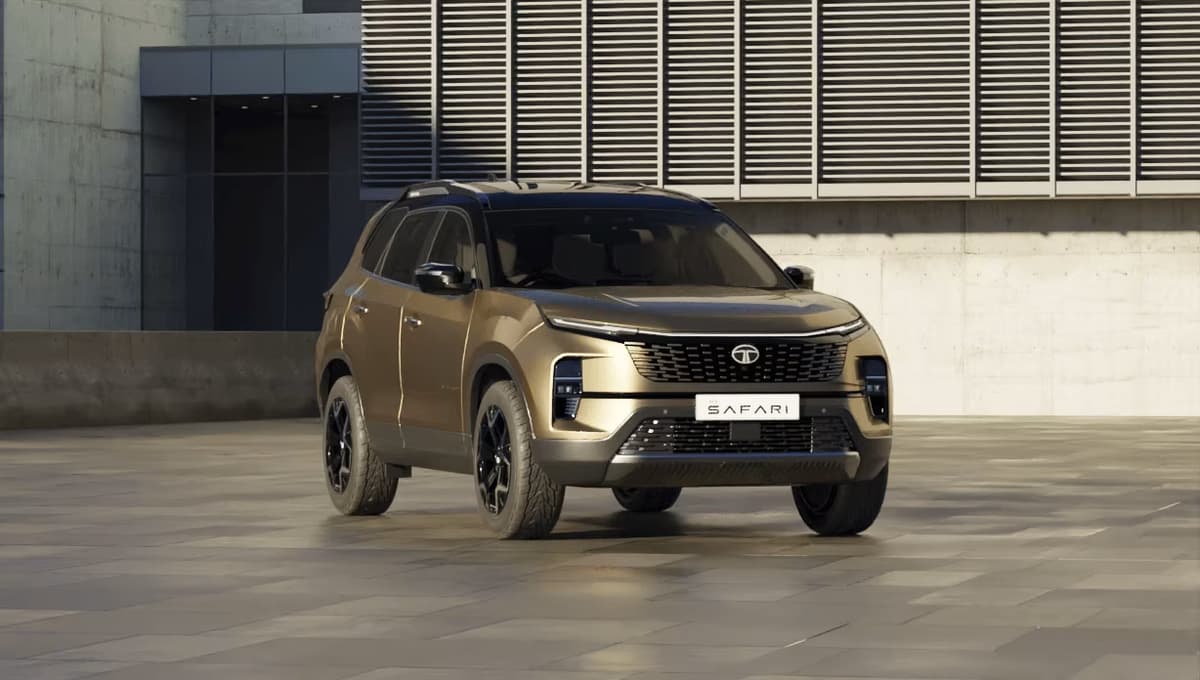
Tata
Safari
Ex-showroom₹13.29 Lakh – ₹26.15 Lakh
- Fuel
- Petrol, Diesel
- Mileage
- 14.8 to 16.3 kmpl
- Engine
- 1498 cc & 1956 cc
- Safety
- 5 Star (Bharat NCAP)
How we researched this
We checked 53 of 53 facts in this report against their source pages: 53 from official sources. Facts we could not verify were left out.
Frequently asked questions
What is a 5-star Bharat NCAP rating?
Under the current BNCAP (AIS-197), a 5-star rating requires a vehicle to score a minimum of 27 out of 32 points for Adult Occupant Protection (AOP) and 41 out of 49 points for Child Occupant Protection (COP) in official crash tests.
How many crash tests does Bharat NCAP currently conduct?
The current Bharat NCAP protocol involves three specific crash tests: a Frontal Offset Impact at 64 km/h, a Side Impact at 50 km/h, and a Side Pole Impact at 29 km/h.
When does Bharat NCAP 2.0 become effective?
The new, more stringent Bharat NCAP 2.0 program is officially planned for implementation starting in October 2027. The current AIS-197 framework is valid until September 30, 2027.
What is the biggest difference in Bharat NCAP 2.0?
Bharat NCAP 2.0 shifts from a star rating based on two scores to a 100-point system across five pillars: Crash Protection (55%), Vulnerable Road User Protection (20%), Safe Driving (10%), Accident Avoidance (10%), and Post-Crash Safety (5%). It also increases mandatory crash tests from three to five.
What score will be needed for a 5-star rating under Bharat NCAP 2.0?
The proposed threshold for a 5-star rating under BNCAP 2.0 is 70 points out of 100 between 2027 and 2029. This will increase to a minimum of 80 points from 2029 to 2031.

Researched & written by
Abhinav SrivastavSenior Automotive Journalist & Editor
Abhinav Srivastav is a Senior Automotive Journalist with over 8 years of experience covering the Indian automobile industry. He specialises in car reviews, EV technology, and in-depth market analysis. Before joining CarBikeGPT, he contributed to leading automotive publications and test-drove over 200 vehicles across segments. His expertise spans petrol, diesel, hybrid, and electric powertrains, with a particular focus on value-for-money buying decisions for Indian consumers.