In this report
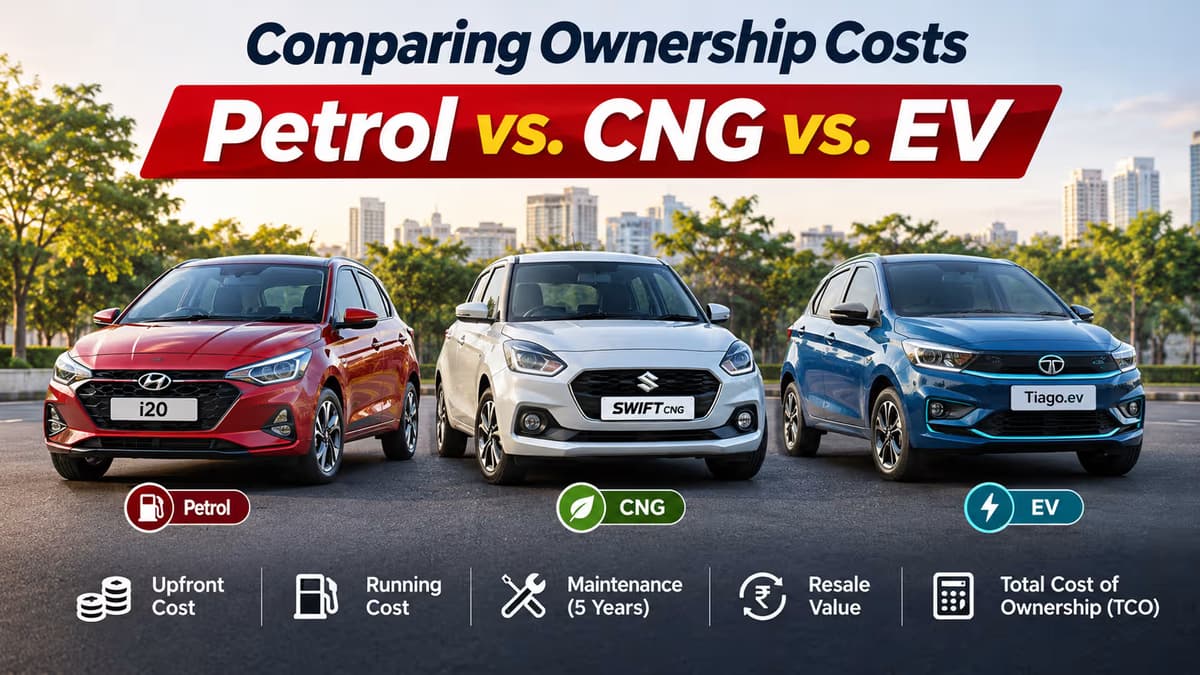
Comparing Ownership Costs: Petrol vs. CNG
For a hatchback buyer in India driving an assumed 1,000 km a month, the choice of fuel can significantly impact long-term expenses. Our analysis uses an assumed purchase price for the petrol hatchback that is lower than the other models in our comparison, and its higher calculated running costs, based on our assumptions, contribute to a greater total ownership cost in this specific long-term scenario.
This article applies a data-driven methodology to compare the five-year ownership costs of a petrol hatchback, a CNG hatchback, and a representative entry-level electric hatchback to provide a clear, calculated illustration of the financial implications of each.
The Contenders and Our Assumptions
To create a direct comparison, we've focused our analysis on the Maruti Suzuki Celerio as an example. For the electric option, we've created a 'Hypothetical Entry EV' with estimated specifications to illustrate the costs involved. This entire analysis is an illustrative model, and your actual costs will vary based on your location, usage, and other factors.

Key assumptions for our 5-year, 60,000 km TCO model:
- Driving Distance: An assumed 1,000 km per month (12,000 km per year).
- Prices (Illustrative): Fuel prices are assumed for Delhi (Oct 2026): Petrol at ₹102.5/litre, CNG at ₹75/kg. Residential electricity is estimated at ₹8/kWh. Ex-showroom prices for the petrol Celerio (assumed at ₹5,18,000) and the Hypothetical EV (assumed at ₹8,50,000) are used for this calculation. The on-road price is calculated using an assumed factor of 1.15 over the ex-showroom price.
- The EV's efficiency is estimated at 10 km/kWh.
- Other Illustrative Costs: This model uses assumed 5-year service costs of ₹20,000 (Petrol), ₹25,000 (CNG), and ₹15,000 (EV). It also includes assumed insurance costs for years 2-5. Depreciation is estimated at 50% of the ex-showroom price over 5 years for all models.
Upfront Costs: The Price of Entry
The on-road price is a significant upfront cost. The ex-showroom price for the CNG model in our example falls between the assumed prices of the petrol and hypothetical EV models. The tables below present an illustrative breakdown based on the assumptions outlined in this article.
Model Variant | Ex-Showroom Price (Delhi) | Estimated On-Road Price |
|---|---|---|
Maruti Celerio (Petrol) | ₹5,18,000 | ₹5,95,700 |
Maruti Celerio (CNG) | ₹5,98,000 | ₹6,87,700 |
Hypothetical Entry EV | ₹8,50,000 | ₹9,77,500 |
In this example, the CNG Celerio costs about ₹92,000 more than its petrol sibling upfront.
Analysing the Running Costs
This is where the ownership equation can change. In our illustrative model, the effect of the petrol Celerio's lower assumed purchase price is offset by its higher calculated fuel costs over the five-year period. In contrast, the calculated per-kilometre running costs for the CNG and hypothetical EV options in our example are lower, which can lead to savings over time.
Fuel Type | Cost per Unit (Assumed) | Efficiency (Assumed Average) | Running Cost per km (Calculated) | Total Fuel/Energy Cost (60,000 km) |
|---|---|---|---|---|
Petrol | ₹102.5/litre | 18 kmpl | ₹5.69 | ₹3,41,400 |
CNG | ₹75/kg | 28 km/kg | ₹2.68 | ₹1,60,800 |
Electric | ₹8/kWh | 10 km/kWh | ₹0.80 | ₹48,000 |
Based on our assumptions, this could amount to spending approximately ₹1,80,600 more on fuel for the petrol car compared to the CNG model over five years. The hypothetical EV's calculated running cost is also lower than the petrol model's in this scenario.
The 5-Year Total Cost of Ownership Verdict
To calculate the Total Cost of Ownership (TCO) for this illustrative comparison, we combine the on-road price with the assumed costs for fuel, service, and insurance over five years, and then subtract the car's assumed resale value. This resulting figure represents an estimate of the total financial outlay for owning and operating the vehicle within our specific model. Note that some figures, such as insurance costs for years two through five, are illustrative assumptions.
Cost Component | Celerio (Petrol) | Celerio (CNG) | Hypothetical Entry EV |
|---|---|---|---|
Total Expenditure (5 Yrs) | ₹10,05,100 | ₹9,25,500 | ₹11,00,500 |
Less: Est. Resale Value | (₹2,59,000) | (₹2,99,000) | (₹4,25,000) |
Total Cost of Ownership (5 Yrs) | ₹7,46,100 | ₹6,26,500 | ₹6,75,500 |
Effective Cost per km | ₹12.44 | ₹10.44 | ₹11.26 |
The data from our illustrative comparison suggests the Celerio CNG has a lower total cost of ownership than the petrol version, costing an estimated ₹1,19,600 less over five years. Interestingly, the hypothetical EV in our model, despite its higher initial price, has a total ownership cost that is approximately ₹70,600 lower than the petrol car's. This highlights the impact of low running costs.
Breakeven Point: CNG vs. Petrol
Based on our model, how long might it take to recover the extra ₹92,000 paid for the CNG model? With a running cost saving of ₹3.01 per kilometre, a driver would need to travel approximately 30,565 kilometres to break even. For someone driving a projected 1,000 km a month, this takes about two and a half years.
The EV Question
Our analysis, using a hypothetical EV, calculates a total cost of ownership that is lower than the petrol car's under these specific assumptions. The calculation in our model results in a total cost of ownership for the hypothetical EV that is higher than the calculated cost for the CNG model. The decision is more complex than just numbers and depends on factors like access to charging and willingness to pay a higher initial price. This illustrative calculation relies on assumed values for 5-year service costs and a home electricity rate, both of which are critical for an exact TCO calculation.
Recommendations: Which Hatchback Fuel Type Might Be Right for You?
Our analysis suggests a petrol car could be a suitable option if: Your annual running is low (e.g., less than 8,000 km) and your primary concern is a lower initial purchase price.
Our analysis suggests a CNG car could be a suitable option if: You are a high-mileage user (e.g., over 10,000 km a year) and aim for a lower total ownership cost, as demonstrated in our comparison.
Our analysis suggests an EV could be a suitable option if: You have a higher budget, predictable daily usage (well within the car's range), and can install a charger at home. Within our illustrative model, the EV's higher assumed initial cost is partly offset by its lower calculated running costs.
Note: Figures in this article are based on manufacturer information, official certifications and independent tests available at the time of writing. Prices, specifications and real-world mileage can vary by variant, city, riding or driving style and over time. Please confirm the latest details with the manufacturer or an authorised dealer, and seek expert advice before making a purchase decision.
Models in this report
Frequently asked questions
Based on this analysis, which fuel type is more economical to own over 5 years?
Based on our illustrative analysis of a 5-year ownership period with an assumed 12,000 km of annual running, our calculation shows a lower total cost of ownership for the CNG model compared to the petrol version in this specific scenario.
How much more expensive is a petrol hatchback to run than a CNG hatchback in this example?
In our illustrative calculation, a petrol hatchback costs approximately ₹5.69 per kilometre to run, while a CNG hatchback costs around ₹2.68 per kilometre. Based on these assumptions, the petrol car's running cost is calculated to be more than double that of the CNG car for every kilometre driven.
Is it worth paying more for a CNG car over a petrol car?
It can be, if you drive enough kilometres annually. Our calculations, based on an assumed 12,000 km of annual driving, show that the higher initial price of the CNG car could be recovered after driving approximately 30,565 km. In this illustrative scenario, this would take about 2.55 years, after which savings on running costs would begin.
Are electric hatchbacks cheaper to own than petrol cars in this analysis?
Yes, our analysis with a hypothetical entry-level EV calculates that despite a much higher purchase price, the EV's total cost of ownership over 5 years is lower than the petrol hatchback's in our model. This is due to its extremely low running costs (around ₹0.80/km in our model) and lower estimated maintenance.

Researched & written by
Abhinav SrivastavSenior Automotive Journalist & Editor
Abhinav Srivastav is a Senior Automotive Journalist with over 8 years of experience covering the Indian automobile industry. He specialises in car reviews, EV technology, and in-depth market analysis. Before joining CarBikeGPT, he contributed to leading automotive publications and test-drove over 200 vehicles across segments. His expertise spans petrol, diesel, hybrid, and electric powertrains, with a particular focus on value-for-money buying decisions for Indian consumers.