What's The Big News?
Picture this: you pull into a chaotic fuel pump on your morning commute, running ten minutes behind for a crucial office meeting. The attendant fills your tank, you reach for your phone to scan a weathered QR code, but the payment gateway hangs because the pump canopy is blocking mobile reception. We have all lived this exact headache in India. Now, Tata Motors and Indian Oil Corporation Limited (IOCL) have decided to cut through the mess with India's very first in-car fuel payment feature.
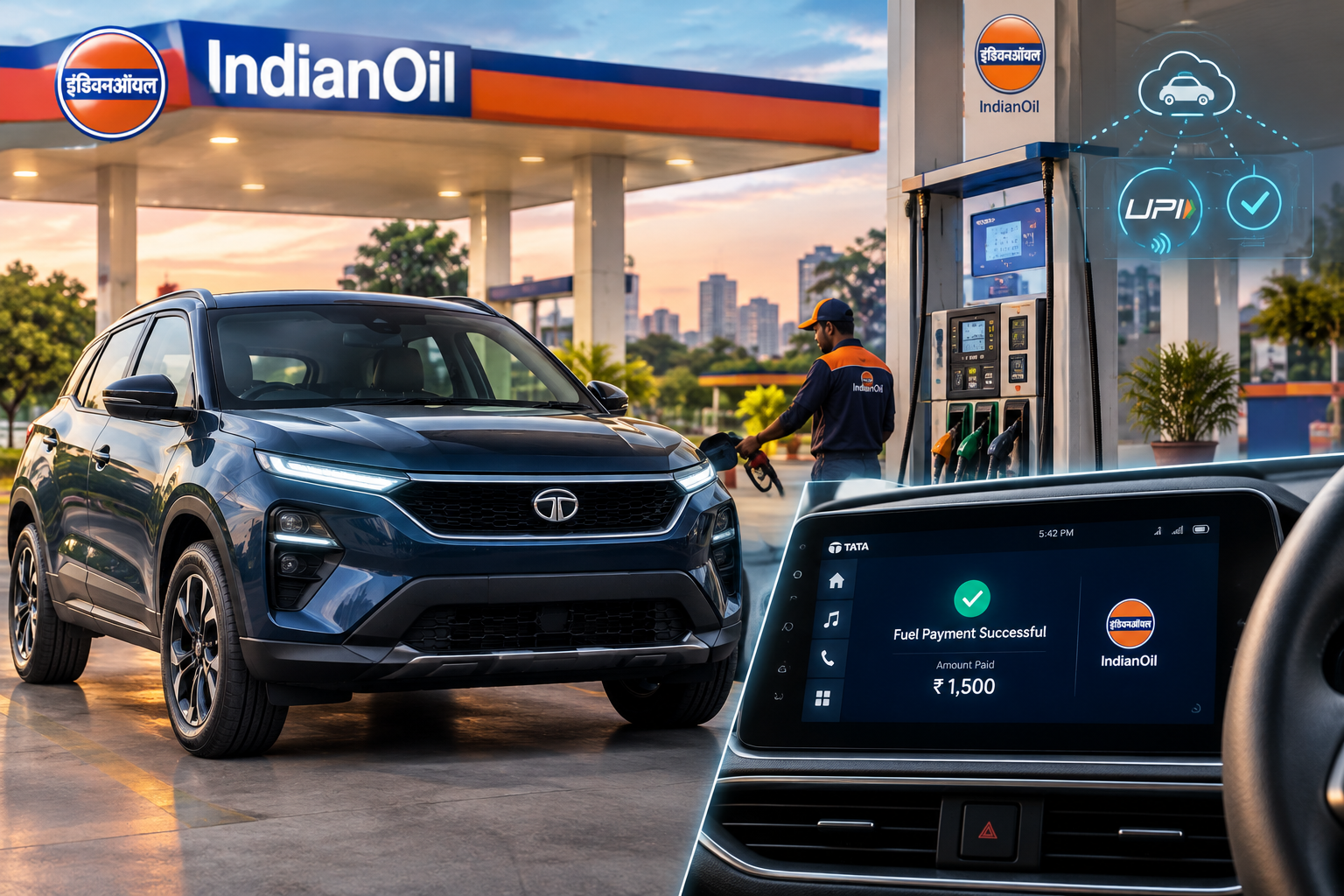
Instead of stepping out into the sweltering heat, fumbling with cash, or waving your smartphone around in an area where mobile phones are technically prohibited anyway, you can now authorize and settle the fuel bill straight from your vehicle's central touchscreen. It marks a significant shift in how connected car software works on our roads. This is no longer just about tracking where your car is parked or turning on the air conditioning remotely—it is about turning your daily driver into an active, functional commerce hub.
How The In-Car IOCL Payment System Actually Works
The magic happens through an integration baked straight into Tata's connected car ecosystem. When you steer your compatible Tata vehicle into a participating IndianOil retail outlet, the car's connected infotainment unit works in tandem with geolocation data and local pump infrastructure to recognize your arrival. The system allows you to select your fuel amount, choose your payment mode, and authorize the transaction directly on the infotainment display (yes, really).
Automakers have spent years trying to figure out what drivers actually want on their screens. While European and American markets have experimented with fast-food drive-through ordering and automated toll payments, fuel payments make infinitely more sense in the Indian landscape. By working directly with IndianOil—the country's largest fuel retailer by network volume—Tata ensures that this is not a tiny pilot restricted to two flagship fuel stations in South Mumbai or Central Delhi. You are looking at a platform built to tap into an enormous real-world footprint across state lines and busy highway corridors.
Why This Beats Pulling Out Your Phone Every Single Time
There is an obvious safety angle here that most marketing brochures gloss over. Every Indian petrol pump carries bold statutory warnings advising motorists not to operate mobile phones while refuelling. Yet, ironically, ninety percent of urban transactions happen via UPI apps on those very same smartphones. Shifting that financial interface inside the cabin to a native, crash-tested dashboard panel keeps you compliant with pump regulations while keeping your eyes on the vehicle's perimeter.
Then there is the sheer convenience factor during our brutal summer heatwaves or sudden monsoon cloudbursts. You pull up, roll down your window just an inch to tell the pump attendant what you need, let the nozzle run, verify the reading on your dash, and settle up via your vehicle's interface. For urban car buyers who treat digital payments like second nature—the crowd picking up a Nexon or a Safari over a bare-bones alternative—this frictionless routine eliminates one of the most annoying pain points of weekly city driving.
Specs At A Glance
Feature / Parameter | Details & Specifications |
|---|---|
Partnering Brands | Tata Motors & Indian Oil Corporation Ltd (IOCL) |
Platform Integration | Tata Connected Infotainment Suite (iRA Compatible) |
Target Vehicles | Select Connected Tata Passenger Vehicles |
Supported Outlets | Authorized IndianOil Fuel Stations Pan-India |
Transaction Mode | Native Digital Payment via Center Screen |
Safety Compliance | Eliminates Handheld Smartphone Use Near Nozzles |
Rollout Phase | Phased Deployment Across Supported Retail Outlets |
How Does It Stack Up Against The Competition?
Connected tech in India has largely been a three-horse race between Tata's iRA, Hyundai-Kia's Bluelink/UVO, and Mahindra's Adrenox suite. Hyundai was one of the early pioneers to integrate third-party FASTag and parking service providers into its UI, but neither Hyundai nor Kia has managed a seamless, nationwide fuel payment roll-out with a domestic oil behemoth like IndianOil. Their interfaces still expect you to finish transactions on your personal device or deal with external handheld POS terminals.
Mahindra's Adrenox software, found inside the XUV700 and Scorpio-N, boasts blistering processing speeds and deep Alexa integrations, yet it remains primarily focused on vehicle diagnostics, travel apps, and cabin entertainment. Maruti Suzuki Connect, meanwhile, sticks to the basics—delivering trip logs, geofencing alerts, and battery status updates without wandering into the territory of active financial transactions. Tata and IndianOil have legitimately grabbed the first-mover advantage here. They took a mundane, compulsory chore and engineered a distinct software-led solution that rivals will now have to duplicate.
The Good And The Not-So-Good
What We Like
- Zero smartphone juggling: No more fishing in pockets or purse straps while balancing a steering wheel.
- Strict pump safety: Avoids using mobile radios right next to active fuel vapor zones.
- Massive potential reach: Teaming up with IndianOil guarantees access to India's widest refuelling network.
- Practical connected tech: Solves a genuine, repetitive daily headache instead of offering silly software gimmicks.
What Could Be Better
- Network dependency: Requires rock-solid onboard cellular coverage to process seamless transactions at remote highway pumps.
- Rollout timelines: Will take time before every rural and semi-urban IndianOil pump staffer knows how to handle in-dash checkouts.
- Screen limitations: Early Tata iRA vehicles with older, laggy infotainment units might miss out on this update.
Price & When You Can Buy It
This is not a standalone accessory you purchase at a dealership parts counter; it is an integrated software feature. Tata Motors plans to deploy the capability across its connected passenger car lineup, specifically models equipped with newer-generation infotainment systems running the connected iRA architecture. If your Tata car already supports connected services, this functionality is expected to roll out via software updates without demanding extra subscription fees for the payment tool itself.
Compatible models naturally include popular nameplates like the Nexon, Harrier, Safari, and Altroz variants that carry high-spec touchscreen units. The rollout at IndianOil fuel bunks will expand gradually, beginning with major metro fuel stations before branching out onto state highways and tier-2 city outlets over the coming months.
Our Verdict
Look, connected car technology in India has spent far too long giving us gimmicks that sound incredible on a sales brochure but end up ignored after the first month of ownership. Nobody buys a car to honk the horn remotely from five kilometers away, and very few people care about asking a voice assistant to open the sunroof when their hand is already two inches from the physical toggle switch.
What we actually need are features that save time, eliminate petty daily frustrations, and make modern motoring smoother. In my opinion, this collaboration between Tata Motors and IndianOil is exactly the kind of pragmatic engineering Indian drivers deserve. If the execution stays responsive, bug-free, and widely supported across pumps, it sets a brand-new benchmark for what an Indian car's dashboard should be doing for its owner.