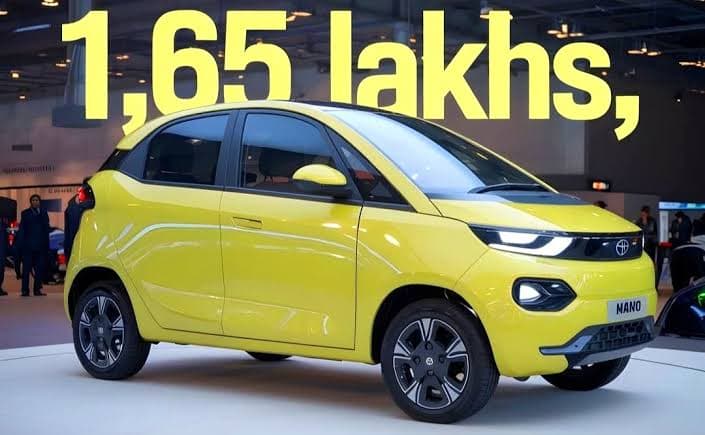
What's The Big News?
Alright folks, listen up! The name 'Nano' still brings up a lot of memories for us, doesn't it? Love it or hate it, the original Tata Nano tried to change the game. Now, fast forward a decade, and the buzz around the automobile circuit is that Tata Motors might just be bringing back the 'people's car' – but this time, it's going fully electric. And honestly, it shows Tata's serious about EVs for everyone.
This isn't just another rumour floating around; reports suggest that Tata is eyeing a comeback for the Nano badge, repackaged as a smart, low-cost EV. Imagine that! A city-friendly electric car from a brand that's already dominating the EV space. If Tata manages to nail the price point, this could be the biggest disruption to the Indian EV market since... well, since Tata themselves launched the tiago-ev">Tiago EV. It’s a move that could put an electric car in more middle-class driveways than ever before.
The Promise of Affordable Electric Mobility
Let's be frank, the biggest hurdle for most Indian families eyeing an EV has always been the price tag. While options like the Tiago EV and Comet EV have brought down the entry barrier, we're still talking about cars that start upwards of ₹8-9 lakh. That's a huge chunk of change for many. The original Nano's promise was a car for the price of a decent motorcycle, and while an EV at that price is a pipe dream in today's tech, a Nano EV could aim to be the most affordable four-wheeler EV on sale.
Here's the thing — if Tata can engineer a Nano EV that offers a practical city range and the essential smart features for a price that genuinely undercuts everything else, it changes the entire narrative. They've got the expertise with Ziptron technology and a robust charging network. Leveraging their existing platforms, perhaps even a highly localised component strategy, could bring down costs significantly. This isn't just about selling a car; it's about giving millions of Indians their first taste of electric driving without breaking the bank. Think about the savings on fuel! That's a major draw for families on a budget.
Premium Look and Smart Features: A Nano Reimagined
Now, let's address the elephant in the room: the 'premium look' and 'smart features' part. The first Nano wasn't exactly known for its plush interiors or cutting-edge tech. It was bare-bones functionality. But for this electric avatar, Tata seems to be taking a different approach. We're expecting a complete design overhaul, moving away from the basic, utilitarian aesthetics to something more modern and appealing, possibly drawing inspiration from Tata's 'Impact' design language seen on the Tiago and Tigor EVs.
What does 'premium look' mean in a budget EV context? It's not about leather seats, obviously. It's about better quality plastics, a more cohesive cabin design, modern colour schemes, and perhaps subtle exterior tweaks like LED DRLs or updated wheel designs that make it look less like an entry-level car and more like a smart, chic city commuter. As for 'smart features', we're likely looking at a touchscreen infotainment system (maybe 7-inch, like the one in lower-spec Tiagos), digital instrument cluster, connected car tech (iRA lite?), keyless entry, and maybe even a rearview camera. These are features that are becoming standard expectations even in entry-level segments, and Tata knows it can't afford to skimp if it wants to shed the old Nano's image.
Specs At A Glance
Since official details are still under wraps, these are our educated guesses based on the 'low price, city car EV' brief:
Feature | Expected Specification |
|---|---|
Battery Pack | Compact lithium-ion, ~15-20 kWh (TBA) |
Range (MIDC) | Expected around 180-220 km (city driving focus) |
Electric Motor | Modest power, suitable for city commutes (TBA) |
Charging (AC) | 3.3 kW onboard charger (standard) |
Charging (DC Fast) | Capability expected, but speed TBA |
Transmission | Single-speed automatic (electric direct drive) |
Seating Capacity | 4 adults |
Infotainment | 7-inch touchscreen with Android Auto/Apple CarPlay (expected) |
Safety Features | ABS with EBD, dual airbags (expected) |
Keyless Entry | Expected |
Digital Cluster | Expected |
Dimensions | Ultra-compact, similar to original Nano but slightly wider |
How Does It Stack Up Against The Competition?
If the Nano EV truly hits that aggressive sub-₹7 lakh (ex-showroom) price point, it doesn't have much direct competition. The closest in terms of concept is the MG Comet EV, which starts around ₹7 lakh. The Comet is quirkier, a two-door, and quite compact, making it a niche product. The Nano EV, being a four-door with potentially more usable space, could offer a more traditional car experience.
Then there's Tata's own Tiago EV, which is currently the segment leader. But the Tiago EV starts significantly higher, pushing into ₹8.69 lakh territory. A Nano EV would sit squarely below it, targeting a different, even more budget-conscious buyer. It's not about outperforming these cars; it's about providing a fundamentally cheaper entry point into the EV world. It might even pull buyers away from top-spec ICE hatchbacks like the Maruti Alto K10 or the Celerio, offering them the benefits of electric at a comparable EMI.
The Good And The Not-So-Good
What We Like
- Potential to be India's most affordable electric car, democratising EVs.
- Tata's proven EV tech and ecosystem (charging, service support).
- Compact size perfect for crowded Indian city roads and parking.
- Significant running cost savings over petrol cars.
- Expected modern features and design, shedding the old Nano's image.
What Could Be Better
- Range might be limited for anything beyond city commutes (inherent in budget EVs).
- Charging infrastructure, though improving, is still a concern for many.
- Balancing cost with perceived quality will be crucial.
- Potential for basic cabin materials to keep costs down.
- The market's previous perception of the 'Nano' brand might need significant re-education.
Price & When You Can Buy It
This is the million-dollar question, isn't it? Or rather, the six-lakh-rupee question! While Tata hasn't uttered a single official word, industry watchers and reports are hinting at an aggressive price strategy. We're talking about a potential starting price possibly in the ₹5-7 lakh (ex-showroom) range. If Tata can achieve that, it’ll be an absolute game-changer, making EV ownership a realistic dream for a much larger segment of the population.
As for availability, don't hold your breath for next month. Development takes time, and Tata will want to get this right. We could see an official announcement or concept unveil later this year, with a market launch likely towards late 2024 or early 2025. But remember, these are just educated guesses until the company makes it official. Keep your eyes peeled, because this could be huge!
Our Verdict
Look, the original Nano had a tough run, but its vision of affordable personal transport was always commendable. Bringing it back as an EV, with a 'premium look' and 'smart features', isn't just a nostalgic move; it's a strategic stroke of genius from Tata. They've cornered the mass-market EV segment with the Tiago and Nexon, and a Nano EV could open up an entirely new entry-level. Honestly, if Tata pulls this off with the right balance of price, range, and features, they won't just sell cars; they'll kickstart an EV revolution for the average Indian family.