What's The Big News?
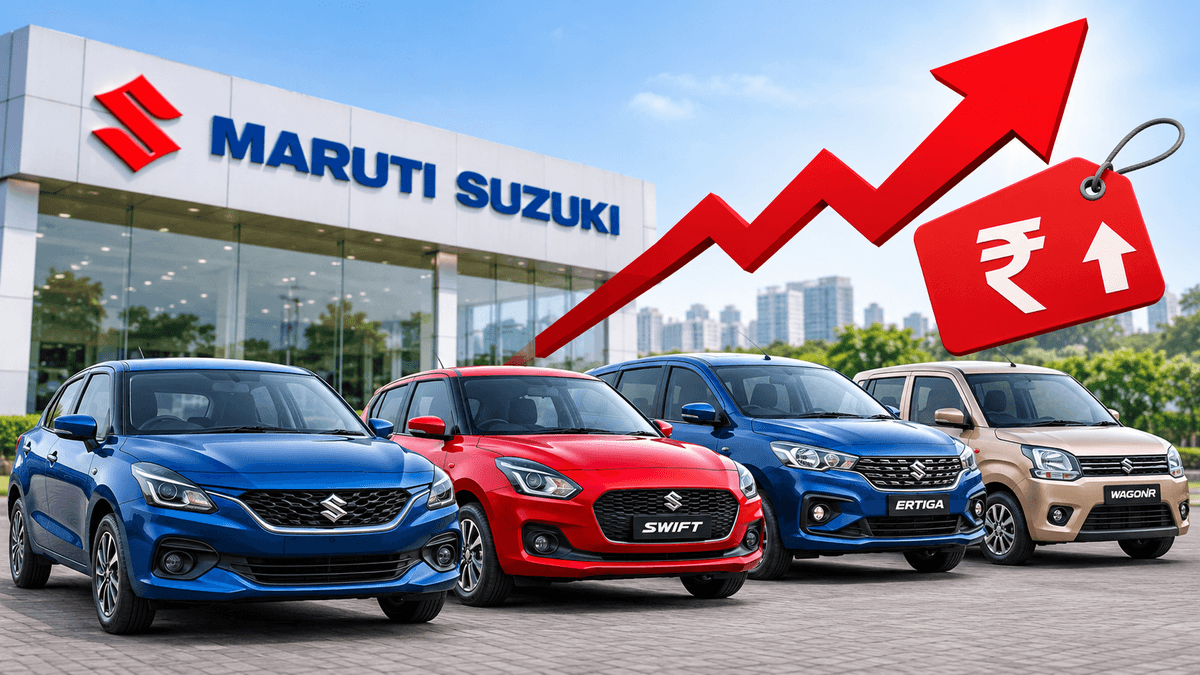
Just when you thought you'd finally saved enough for that shiny new Maruti, here's a fresh jolt for your wallet. Maruti Suzuki, the undisputed king of India's passenger vehicle segment, has announced a price hike across 'select models,' effective from today. It's not a complete shocker, given the way raw material costs have been behaving, but it still stings, doesn't it?
For millions of Indian families, a Maruti isn't just a car; it's a statement, a milestone, often the first big purchase after years of saving. This price adjustment, even if marginal, impacts those dreams directly. So, if you've been sitting on the fence, perhaps waiting for the 'right time' to buy your favourite Swift or Baleno, you're now looking at a slightly higher asking price.
The Latest Jolt: Maruti's Price Increase Explained
Maruti Suzuki hasn't been shy about citing the usual suspects behind these hikes. We're talking about the relentless rise in input costs – everything from steel and aluminium to precious metals used in catalytic converters. Add to that the ever-tightening regulatory requirements, which often demand more advanced and thus pricier components, and you've got a recipe for upward price adjustments.
While the company hasn't revealed the exact percentage of the hike or the specific models affected (you'll need to check with your local dealership for the precise figures), such announcements typically translate to a marginal increase, often between 0.5% to 1.5% on the ex-showroom price. It might not sound like much on paper, but for a car costing, say, ₹8 lakh, even a 1% hike adds ₹8,000 to the bill. That's a month's worth of fuel for many, or a couple of EMIs on a small personal loan. This isn't the first time Maruti has done this this year, and honestly, it shows how much pressure automakers are under to maintain profitability amidst global economic headwinds.
What This Means For Indian Buyers
Here's the thing — for the budget-conscious Indian buyer, every rupee matters. A few thousand rupees extra can genuinely push a model out of reach for some, or at least make them reconsider their variant choice. It affects loan amounts, EMIs, and the overall affordability factor that Maruti has historically championed.
This hike comes at a time when the market is still finding its footing post-festive season. While demand for personal mobility remains strong, especially in tier-2 and tier-3 cities, continuous price increases could lead to some buyers delaying their purchases or, worse, looking at the used car market more seriously. It's a delicate balance for Maruti: absorb costs and hit profits, or pass them on and risk denting sales volume. We feel they've opted for a middle path, hoping brand loyalty and an unmatched service network will see them through.
Specs At A Glance
Since this announcement is about a price hike on existing models rather than a new launch or updated variant, there are no new 'specs' to list here in the traditional sense. The core specifications of Maruti Suzuki's various models, be it engine options, safety features, or infotainment systems, remain as they were before this price adjustment.
Advertisement
Feature Category | Maruti Suzuki Typical Offering |
|---|---|
Engine Options | Efficient Petrol & S-CNG (select models) |
Transmission | 5-speed Manual, AGS (AMT) |
Fuel Efficiency | Known for Best-in-Segment figures |
Safety Features | Dual Airbags, ABS with EBD (Standard on most) |
Infotainment | SmartPlay Studio Touchscreen (Higher variants) |
Service Network | Extensive pan-India dealership & service network |
How Does It Stack Up Against The Competition?
Maruti Suzuki's biggest strength has always been its sheer value-for-money proposition, backed by bulletproof reliability and an unparalleled service network. But with each price hike, that 'value' equation shifts a little. Rivals like Tata Motors and Hyundai are aggressively pushing their products, often offering more features, better build quality, and contemporary designs for similar money.
Take the compact SUV segment, for instance. The Brezza, despite its recent refresh, faces stiff competition from the Nexon and Venue. If the Brezza's price inches up, it makes the decision harder for a buyer. Similarly, in the hatchback space, models like the Grand i10 Nios or even the Punch might start looking more attractive if Maruti's popular offerings become too expensive. Maruti's fuel efficiency and low maintenance costs are still massive drawcards, but the initial purchase price is a crucial psychological barrier for many Indian buyers, and repeated hikes chip away at that.
The Good And The Not-So-Good
What We Like
- Unmatched Reliability: Maruti cars are still workhorses, built to last and handle Indian road conditions.
- Fuel Efficiency: They remain segment leaders in mileage, crucial for daily commutes and long drives.
- Extensive Service Network: You'll find a Maruti service centre practically everywhere, which is a huge peace of mind.
- High Resale Value: Maruti cars hold their value incredibly well in the used car market.
What Could Be Better
- The Price Hike Itself: Obviously, nobody likes paying more for the same product.
- Value Perception: Repeated hikes might make some models feel less 'value for money' compared to feature-rich rivals.
- Feature Set & Safety: While improving, some rivals still offer a more comprehensive feature list or higher safety ratings at competitive price points.
Price & When You Can Buy It
The price hike for select Maruti Suzuki models is effective today, as announced by the company. As for specific figures, Maruti hasn't released a model-wise breakdown of the increase. Our advice? If you're planning to buy a Maruti in the coming weeks, rush to your nearest dealership. They'll have the updated price lists for the affected models. Expect a marginal increase, but every rupee saved is a rupee earned, right?
This isn't a pre-booking scenario for new models; it's an adjustment to the existing lineup's pricing. So, the moment you sign on the dotted line today, the new prices apply. Don't rely on old quotes or online aggregators without cross-checking with a showroom first.
Our Verdict
Honestly, a price hike from Maruti Suzuki isn't exactly breaking news in the grand scheme of things. It's an inevitable consequence of rising production costs and inflationary pressures that every manufacturer faces. Maruti, being the volume leader, often has to make these tough calls to protect its bottom line.
For the average Indian buyer, this means a bit more budgeting, a little more stretching. Will it deter them from buying a Maruti? For most, probably not significantly, thanks to the brand's rock-solid reputation and extensive ecosystem. But it does make the competition look a tad more appealing in certain segments. Look, while it stings, Maruti's core strengths of reliability, efficiency, and fantastic service still shine through, even with a slightly higher price tag. It just means you'll have to weigh your options a bit more carefully now.