What's The Big News?
Alright folks, if you've been following the Indian auto scene, you know two names have been buzzing louder than a Diwali firecracker: the Tata Sierra EV and the Mahindra BE.06 Sporteq. These aren't just new electric vehicles; they're statements. Tata's bringing back an icon in an electrifying avatar, while Mahindra's BE line-up is pushing boundaries with its 'Born Electric' vision. Both promise to be absolute game-changers in the burgeoning electric SUV segment, and honestly, the excitement is palpable.
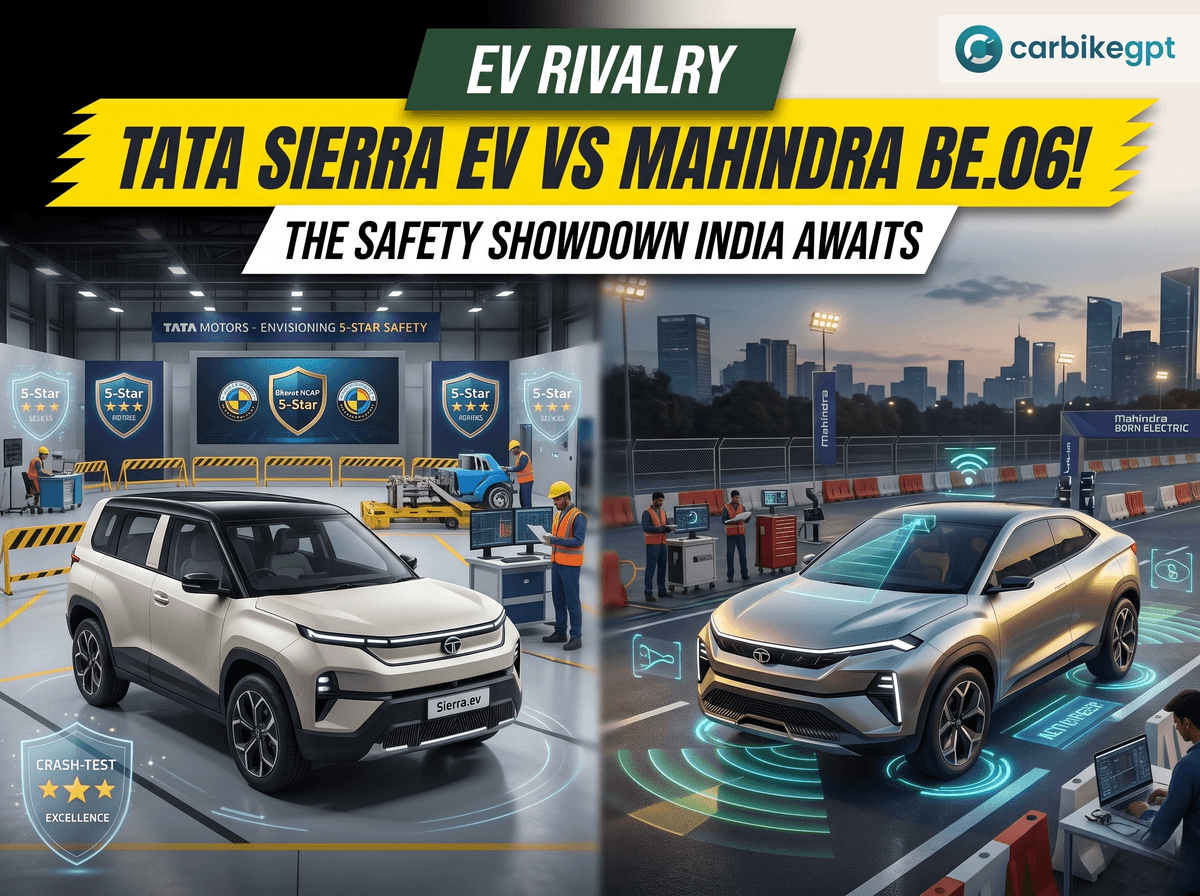
But amidst all the talk of sleek designs, futuristic tech, and potential ranges, there's one critical conversation that's starting to dominate the chai-pe-charcha: their Bharat NCAP safety ratings. With Indian buyers becoming increasingly safety-conscious – and rightly so – the performance of these two giants in crash tests isn't just a spec sheet entry; it's a make-or-break deal. Everyone's waiting to see who'll emerge as the safer bet, and what these results will mean for the future of Indian EVs. It's not just about stars anymore; it's about trust.
Safety First: Why Bharat NCAP Matters for These EVs
Look, for years, we've had to make do with safety ratings from global bodies, or worse, just hope for the best. But with Bharat NCAP now firmly in play, things have changed dramatically. It's a game-changer, especially for vehicles like the Sierra EV and BE.06 Sporteq, which are going to be premium, aspirational products for many Indian families. When you're shelling out the price of a small apartment for your dream car, you expect nothing less than top-tier protection.
Both Tata and Mahindra have built reputations for focusing on safety in their ICE vehicles. Tata, especially, has been a pioneer with multiple 5-star rated cars. So, the expectation from the Sierra EV is naturally sky-high. Can they translate that safety DNA into a dedicated electric platform? That's the big question. For Mahindra's BE.06, which is part of their 'Born Electric' family, the challenge is to prove that their new architecture isn't just about design and performance, but also about foundational safety. EVs have their own unique safety considerations, like battery pack integrity during a crash and managing high-voltage systems. A strong Bharat NCAP showing would instantly alleviate many of these concerns for potential buyers, solidifying their confidence in these new-age machines.
Design & Platform: Underpinnings of Future Safety
Let's talk about what's underneath these exciting skins. The Tata Sierra EV, from what we've seen in concepts, is a modern take on a classic, built on a dedicated EV architecture – likely a heavily modified version of their Gen 2 or Gen 3 EV platform. This means engineers can design the chassis from the ground up with battery protection and crash-energy absorption in mind, rather than retrofitting an existing ICE platform. That's a huge advantage, as it often leads to superior structural rigidity and better passive safety outcomes. It's about building safety in, not bolting it on.
Mahindra's BE.06 Sporteq is part of their ambitious 'Born Electric' (BE) range, riding on the brand-new INGLO platform. This modular EV-specific platform is designed for a variety of body styles and promises advanced battery management and robust crash structures. Mahindra is clearly putting a lot of eggs in the INGLO basket, banking on it to deliver class-leading performance, range, *and* safety. The fact that these vehicles are being conceived as EVs from day one means their inherent safety potential should be higher. This is a far cry from the early days of EVs that were essentially electrified versions of petrol cars, and honestly, it shows in the thoughtful engineering these new platforms bring.
Specs At A Glance
Feature | Tata Sierra EV | Mahindra BE.06 Sporteq |
|---|---|---|
Powertrain | Expected Electric | Expected Electric |
Battery Capacity | Expected large capacity | Expected large capacity |
Expected Range (ARAI) | TBA | TBA |
Platform | Expected dedicated EV platform | INGLO (Born Electric) Platform |
Body Style | 5-door SUV | SUV Coupe |
Expected Launch | Late 2024 / 2025 | Late 2024 / 2025 |
Expected Drive Type | FWD / AWD options likely | FWD / AWD options likely |
Advertisement
How Do They Stack Up Against The Competition?
Currently, the Indian EV SUV market has players like Tata's own nexon-ev">Nexon EV Max, the Mahindra XUV400, and soon, we'll see the Hyundai Creta EV. The Sierra EV and BE.06 are expected to slot into a slightly more premium segment, possibly competing with the upcoming Maruti eVX or even higher-end offerings. Their unique selling proposition won't just be their futuristic designs or brand heritage; it'll be a combination of range, features, and crucially, safety.
If both these vehicles manage to secure strong Bharat NCAP ratings – say, four or five stars – they'll immediately set a new benchmark in their price bracket. It gives them a significant edge over any competitor that might compromise on structural integrity or battery protection. For a family considering an expensive electric SUV, a proven safety record translates directly into peace of mind, a factor that often outweighs marginal differences in range or infotainment features. We're talking about a segment where buyers are willing to pay more for quality and reassurance, and safety is a huge part of that.
The Good And The Not-So-Good
What We Like
- Dedicated EV Platforms: Both are built on ground-up EV architectures, promising better integration of components and potentially superior safety.
- Anticipation of Strong Safety: Given both brands' track record, expectations are high for impressive Bharat NCAP results.
- Striking Designs: The Sierra's iconic revival and BE.06's futuristic coupe-SUV styling are sure to turn heads.
- Homegrown Innovation: It's great to see Indian manufacturers pushing boundaries in the EV space.
What Could Be Better
- Concrete Details: We're still light on official specs, features, and firm launch timelines. The wait is excruciating!
- Charging Infrastructure: While improving, the wider charging network still needs to catch up to the influx of new EVs.
- Potential Premium Pricing: These are likely to be positioned above current budget EVs, which might be a barrier for some.
- Real-world Performance: While concepts look great, the actual production models need to deliver on promises for range and efficiency.
Price & When You Can Buy It
Alright, the million-dollar question – or rather, the ₹20-lakh question! Since these are still a little way off from their full market launch, exact pricing is, understandably, under wraps. However, we expect both the Tata Sierra EV and the Mahindra BE.06 Sporteq to be positioned in the premium end of the mainstream EV SUV segment. You're likely looking at a price range that could start anywhere from ₹20 lakh and go up to ₹30 lakh (ex-showroom) for the higher variants, depending on battery size and features.
As for when you can get your hands on them, don't hold your breath just yet. We anticipate both models will see a market launch sometime in late 2024 or, more realistically, early to mid-2025. Tata usually reveals its plans in phases, and Mahindra's BE range is a multi-product strategy. So, while the anticipation is high, patience will definitely be a virtue for potential buyers.
Our Verdict
The Tata Sierra EV and Mahindra BE.06 Sporteq aren't just vehicles; they represent the future of Indian electric mobility. They're about ambition, design prowess, and a commitment to a greener tomorrow. But in a market where buyers are savvier than ever, and safety is no longer a luxury but a necessity, their Bharat NCAP performances will speak volumes. Here's the thing — for Indian buyers who save up for years and value safety above all else, these Bharat NCAP results will be the ultimate deciding factor, more than any fancy feature or cutting-edge infotainment. We're on the cusp of an exciting new chapter, and how these two perform in the crash lab will determine their legacy on Indian roads.