What's The Big News?
Alright, folks, gather 'round. We've got some fresh news that might just make your wallet feel a little lighter if you've been eyeing a new Kia. Just when you thought you had your budget sorted for that dream Sonet or Seltos, Kia India has decided it's time for another price adjustment.
Yep, you heard that right. Starting July 2026, popular models like the Sonet, Seltos, and the recently launched carens-clavis">Carens Clavis variants are all set to get pricier. We're talking about a hike of up to ₹38,500, which, for many, isn't exactly chump change. This isn't a small nudge; it’s a significant bump, representing up to 2% of their current ex-showroom prices. It feels like these hikes are becoming a regular feature, doesn't it?
The Latest Price Jump Explained
So, what's behind this latest move? Carmakers often cite rising input costs – everything from raw materials like steel and precious metals to logistics and supply chain disruptions. While Kia hasn't officially detailed the exact reasons for this specific hike, it's a common industry practice. Manufacturers absorb costs for a while, but eventually, some of that gets passed on to the consumer. It's the cycle of the auto industry, unfortunately.
Now, let's talk about that ₹38,500 figure. That's the maximum increase you could see. It's crucial to understand that these hikes are rarely uniform across all variants. Typically, the higher-end, more feature-packed variants tend to see a larger absolute increase, even if the percentage remains similar. For someone saving up for a top-spec Seltos, this could mean pushing their budget further, or perhaps rethinking their choice of variant. Imagine saving for months, only to find the car you want is suddenly almost forty thousand rupees more expensive – it's a real pinch.
This up to 2% increment might seem small on paper, but when you're dealing with vehicles that already cost upwards of ₹8-10 lakh, it adds a substantial amount to the on-road price after registration and insurance. It’s not just about the ex-showroom tag; that percentage affects everything down the line. We've seen this play out with other manufacturers too, and honestly, it shows how volatile the market can be for the consumer.
Impact on Your Favourite Kia Models
Let's break down what this means for the specific models that are getting the price treatment:
Kia Sonet: The Compact SUV Contender
The Sonet has been a strong player in the fiercely competitive compact SUV segment. It’s got that aggressive styling, a feature-loaded cabin, and a range of engine options that appeal to a wide audience. Rivals like the Maruti Brezza, Hyundai Venue, and Tata Nexon are always breathing down its neck. A price hike here, even a modest one, makes its position just a little bit tougher. Buyers in this segment are extremely price-sensitive; every rupee counts. Will it make a prospective buyer shift their gaze towards a slightly more affordable rival? It's a real possibility.
Kia Seltos: The Mid-Size SUV Kingpin
The Seltos, in my opinion, redefined the mid-size SUV segment when it first launched. It's still a fantastic package, offering a premium experience, powerful engines, and a long list of features. It goes head-to-head with the likes of the Hyundai Creta, Maruti Grand Vitara, and Skoda Kushaq. A price increase here pushes it further up the value ladder, potentially making it a stretch for some buyers who were on the fence between a Seltos and a well-specced Creta or even a base model of a segment above. It’s about maintaining that perceived value, and price hikes always test that.
Kia Carens Clavis: The Family Mover
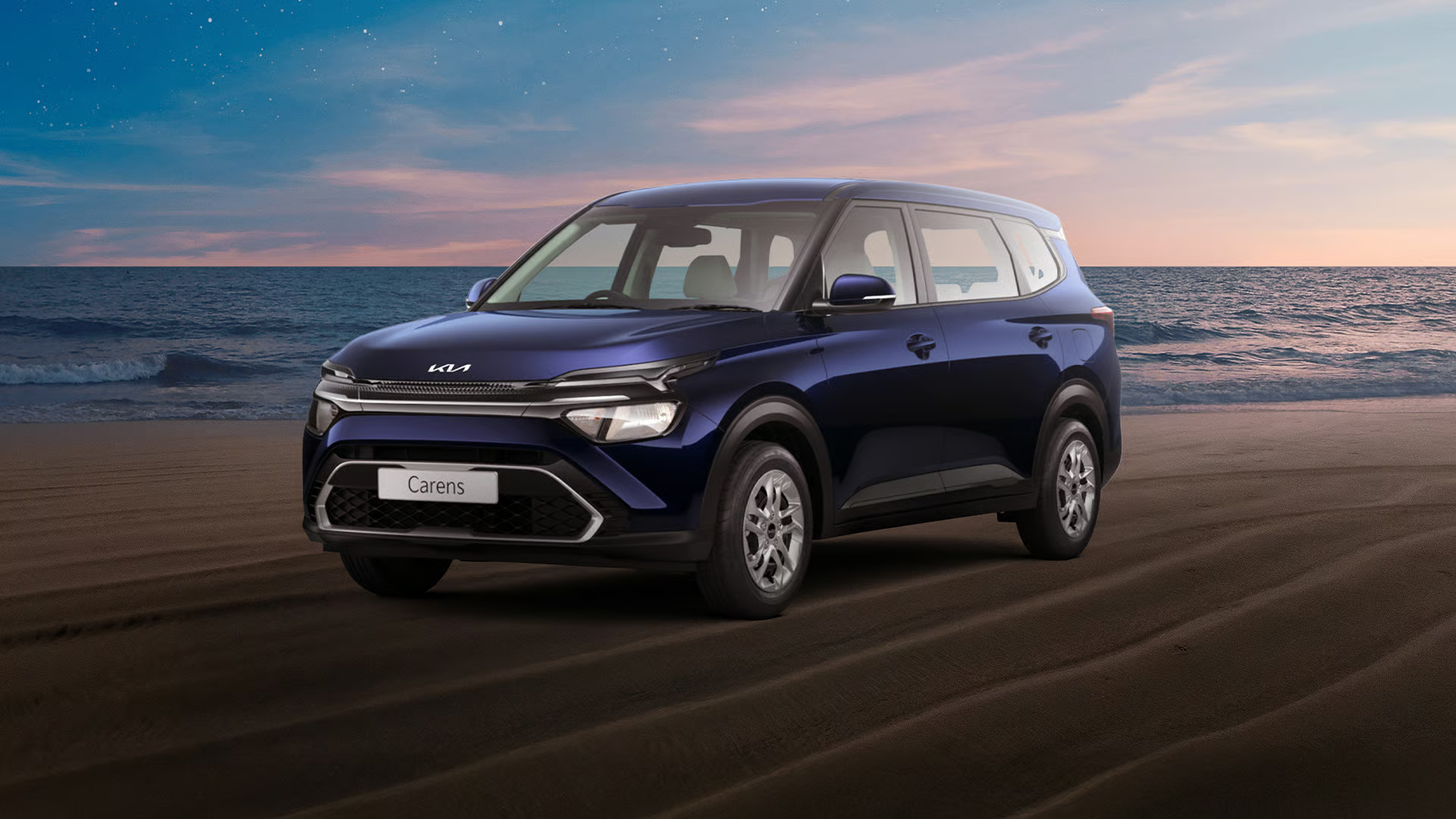
The Carens, especially its Clavis variants, offers a compelling package for those needing a practical and stylish family vehicle without breaking the bank for a full-size SUV or MPV. It sits nicely between an MPV and an SUV, carving its own niche. Its main rivals include the Maruti XL6 and to some extent, the Hyundai Alcazar. While the Carens still offers superb value for its space and features, a price hike could narrow the gap with the Alcazar, forcing buyers to reconsider if the extra cost still justifies their choice over other 6 or 7-seater options. Value is key in this segment, and any increase impacts that equation.
Specs At A Glance
Here’s a quick overview of the models affected by Kia's July 2026 price revision:
Model | Maximum Price Hike (effective July 2026) | Percentage Increase (up to) |
|---|---|---|
Kia Sonet | ₹38,500 | 2% |
Kia Seltos | ₹38,500 | 2% |
Kia Carens Clavis Variants | ₹38,500 | 2% |
Note: Specific variant-wise price revisions will be announced by Kia India closer to the effective date. The ₹38,500 figure represents the maximum increase across the affected models.
How Does It Stack Up Against The Competition?
This is where things get interesting. In India, a few thousand rupees can sway a buyer's decision, especially in these competitive segments. Let’s see how this hike might shake things up:
For the Sonet, already battling it out with the likes of the Brezza and Nexon, this price bump makes the decision even harder. The Brezza, known for its Maruti reliability and after-sales service, offers strong value. The Nexon, with its 5-star safety rating and increasing feature set, is another tough competitor. If the Sonet's top variants get the full hike, it might push them uncomfortably close to the starting price of the next segment, making buyers think twice.
The Seltos, a segment leader, faces intense competition from its cousin, the Hyundai Creta, which often plays the price game aggressively. Then there's the Maruti Grand Vitara and Toyota Hyryder, offering strong hybrid options, which are gaining popularity. Skoda Kushaq and VW Taigun also offer German engineering and driving dynamics. A price hike for Seltos means it needs to lean even harder on its feature list, design, and overall premium feel to justify the extra cost. For the price of a mid-spec Swift, you're now paying more for a Seltos.
And then there's the Carens Clavis. This model has been a compelling choice for families. Its rivals, primarily the Maruti XL6, offer a slightly more utilitarian but highly fuel-efficient package. The Hyundai Alcazar, while pricier, offers a more premium, SUV-like experience. This price increase for the Carens could blur the lines a bit, making the Alcazar's entry-level variants seem like a closer proposition. Buyers looking at the Carens are often looking for the best bang-for-buck family car, and any increase directly impacts that.
The Good And The Not-So-Good
What We Like
- Feature-Rich Offerings: Kia vehicles, even with a price hike, generally come loaded with features that often surpass what rivals offer at a similar price point. You still get a lot of tech and convenience for your money.
- Strong Design Language: Kia cars continue to boast a bold, attractive design that stands out on Indian roads. They don't compromise on style.
- Variety of Powertrain Options: From turbo petrol to diesel, Kia gives buyers choices, which is always a plus in a diverse market like ours.
What Could Be Better
- Frequency of Price Hikes: It feels like we're seeing these adjustments quite often from Kia. This can be frustrating for potential buyers trying to plan their purchases.
- Transparency on Specific Variant Hikes: While we know the maximum, clearer communication on how the hike impacts each specific variant would be beneficial for consumers.
- Impact on Value Proposition: With increasing prices, Kia needs to continually ensure its vehicles remain perceived as strong value-for-money propositions against increasingly competitive rivals.
Price & When You Can Buy It
So, when does this all kick in? The price hike for the Kia Sonet, Seltos, and Carens Clavis variants is effective from July 2026. This means if you've been holding out, now might be the time to make a move if you want to lock in current prices. Dealerships will likely have the revised price lists available closer to the effective date, so it's always best to check with your nearest Kia showroom.
Remember, the "up to ₹38,500" figure is a maximum. It's highly probable that the base variants will see a smaller increase, while the top-spec, fully loaded trims might bear the brunt of the full hike. This is standard practice in the industry. Unfortunately, official figures are yet to be revealed for individual variants, so it’s a bit of a waiting game for precise numbers. Your best bet is to talk to a dealer if you’re planning a purchase soon.
Our Verdict
Look, price hikes are an inevitable part of the automobile industry. Input costs rise, regulations change, and manufacturers need to maintain their margins. However, for a market as price-sensitive as India, and for enthusiasts who save up every rupee, these frequent adjustments can be disheartening. Kia has built a strong reputation for offering feature-packed, stylish vehicles at competitive prices.
Honestly, for buyers planning their purchase, this hike is a bit of a dampener. It means you'll either have to shell out more for the same car or perhaps compromise on a variant. My advice? If you're seriously considering a Sonet, Seltos, or Carens, talk to your dealer right away. See if you can get your booking in before July 2026 to avoid the increase. Kia makes great products, no doubt, but staying competitive on price is always a tightrope walk. Let's hope these increases don't dull their shine too much for the Indian car buyer.