What's The Big News?
If you've been holding onto your hard-earned cash waiting for the next big wave of family cars, I've got some serious news for you. India's biggest carmaker and Japanese automotive giant Toyota are preparing to drop four brand-new models into our market. We aren't just talking about minor bumper tweaks or new sticker packages here. These are ground-up new electric vehicles, practical three-row SUVs, and high-efficiency hybrids designed specifically for Indian buyers.
For anyone planning to upgrade from a humble hatchback or trying to dodge rising fuel bills, this joint pipeline is going to change the game. The alliance between Maruti Suzuki and Toyota has already given us solid hits like the Grand Vitara and Urban Cruiser Hyryder. Now, they're taking that partnership into top gear with new segments, larger seating layouts, and full battery-electric powertrains that promise real-world usability without making a massive dent in your savings.
Upcoming Maruti-Toyota Electric SUVs Take Center Stage
Electric mobility is finally reaching the mass market in a big way, and Suzuki's first global EV—previewed as the eVX concept—is leading the charge. This isn't a retrofitted petrol car with a battery slapped underneath. It's built on a dedicated electric platform developed jointly with Toyota, meaning interior space, floor layout, and weight distribution should be top-tier. Expect a slick, futuristic design language outside, coupled with a tech-heavy cabin inside that easily puts older Maruti interiors to shame (and honestly, it shows how fast they've caught up).
Toyota will sell its own styled counterpart of this SUV, boasting distinct front-end styling and unique interior touches. Both models are expected to feature dedicated EV battery packs with claimed driving ranges comfortably above 400 km on a single charge. You'll also get options for single-motor front-wheel drive as well as dual-motor all-wheel drive configurations. For buyers who want zero tailpipe emissions without giving up rugged road presence, these two electric siblings are going to be worth every month of waiting.
Three-Row Hybrids And Mass-Market Crossovers
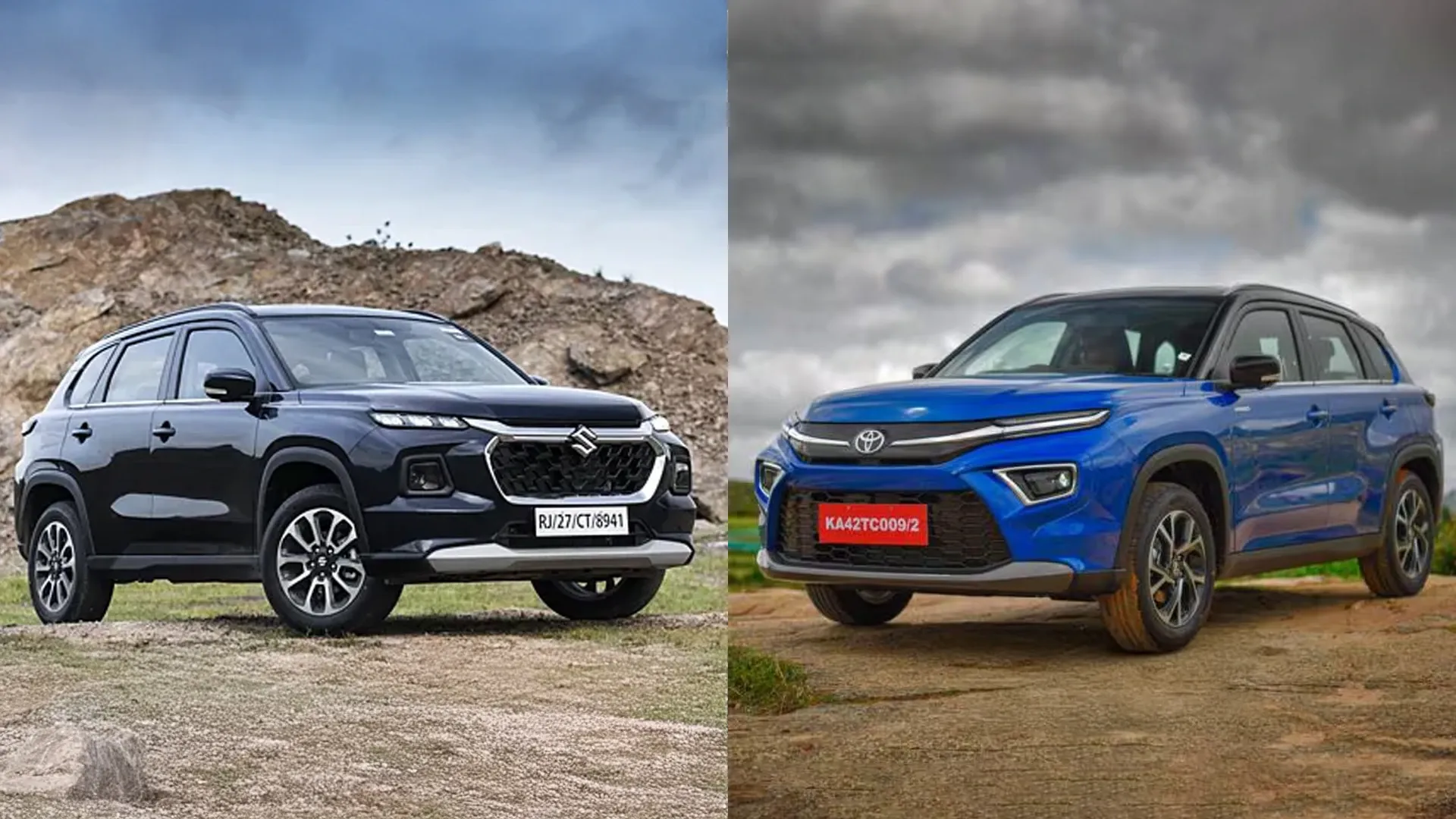
For large Indian families who still find two-row SUVs a bit cramped during highway road trips, a three-row version of the Grand Vitara and Hyryder platform is currently in the works. Imagine all the fuel-sipping benefits of Toyota's strong-hybrid tech, but with extra seating for the kids, grandparents, and luggage. It'll feature an extended wheelbase, redesigned rear quarter glass, and upgraded cabin materials to justify its position above the current mid-size SUV lineup.
Beyond three-row haulers, the duo is also eyeing entry-level hybrid and compact crossover segments. With petrol prices staying stubbornly high across Indian cities, offering a strong-hybrid setup at a price point close to a mid-spec sedan or compact SUV could completely alter buying habits. Maruti's localized manufacturing muscle combined with Toyota's hybrid expertise means maintenance costs should stay reasonable, making long-term ownership practically stress-free for middle-class households.
Specs At A Glance
Model / Expected Vehicle | Powertrain Options | Estimated Range / Mileage | Seating Capacity | Platform |
|---|---|---|---|---|
Maruti eVX / Toyota EV Twin | Electric (50kWh - 60kWh battery expected) | 400km - 500km (claimed, expected) | 5 Seater | Dedicated EV Platform |
7-Seater Grand Vitara / Hyryder | 1.5L Petrol / 1.5L Strong Hybrid | 20 - 27 km/l (expected) | 6 / 7 Seater | Suzuki Global C-Platform |
Compact Hybrid Crossover | 1.2L Petrol / Mild Hybrid / Hybrid | 22 - 28 km/l (expected) | 5 Seater | HEARTECT Platform |
Mass-Market Urban EV Twin | Electric (Entry Battery Pack) | 300km - 350km (expected) | 5 Seater | Modified Modular Platform |
How Does It Stack Up Against The Competition?
Putting these upcoming cars next to current market favorites paints an interesting picture. The upcoming Maruti and Toyota electric SUVs will square off directly against established heavyweights like the Tata Nexon EV, curvv-ev">Curvv EV, and Hyundai Creta EV. While Tata holds a huge first-mover advantage in India's EV space, Maruti's massive service network spanning every corner of the country could convince hesitant buyers in Tier-2 and Tier-3 cities to finally make the switch to electric.
Meanwhile, the three-row hybrid SUVs will lock horns with popular family haulers like the Hyundai Alcazar, Mahindra XUV700, and Tata Safari. While the XUV700 offers brute turbo-petrol power, it can't match the phenomenal real-world fuel economy of a Toyota-backed strong hybrid system. For buyers who prioritize running costs and long-term mechanical reliability over sheer zero-to-100 acceleration, these upcoming Japanese three-row SUVs will pose a serious threat.
The Good And The Not-So-Good
What We Like
- Dedicated EV platform means optimized cabin space and better battery placement.
- Unmatched fuel economy potential from proven strong-hybrid tech.
- Massive service network and easy availability of spare parts across India.
- High resale value potential typical of Maruti and Toyota badges.
What Could Be Better
- Launch timelines can feel stretched compared to aggressive rivals like Tata and Mahindra.
- Strong-hybrid variants might command a steep price premium over standard petrol models.
- Rebadged designs sometimes lack distinct visual separation between Maruti and Toyota versions.
Price & When You Can Buy It
Official prices are yet to be announced by both manufacturers, but we can make educated estimates based on current positioning. The electric SUV lineup (eVX and its Toyota sibling) is expected to arrive first, with estimated pricing likely starting in the ₹18 lakh to ₹24 lakh range. Deliveries are expected to commence in 2025 following their formal debut.
As for the 7-seater Grand Vitara and Hyryder derivatives, expect pricing to range between ₹15 lakh for base petrol variants and up to ₹23 lakh for top-spec strong hybrids. These family SUVs are slated to hit showrooms within the next 12 to 18 months, giving buyers plenty of time to plan their family upgrades.
Our Verdict
Here's the thing — Maruti Suzuki and Toyota aren't trying to build flashy garage queens for wealthy collectors. They are building smart, economical, everyday vehicles for real Indian families who care about running costs, reliability, and hassle-free ownership. Whether you want to jump straight into electric mobility or need a comfortable 7-seater hybrid for family road trips, this upcoming lineup covers almost every base. If you can hold off your buying decision for a few months, your patience will likely pay off in a very big way.