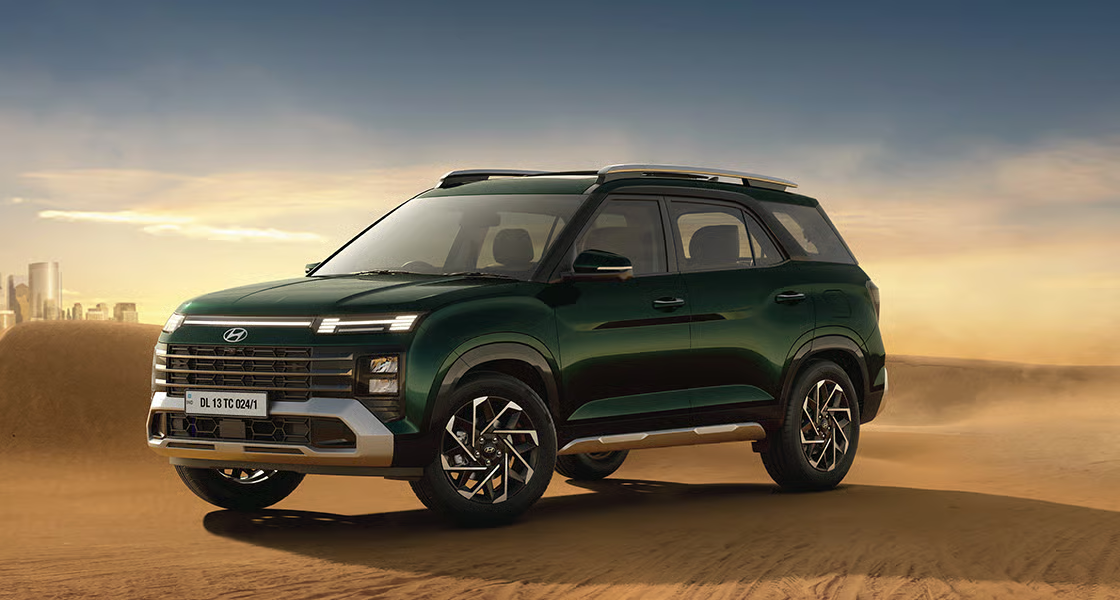
What's The Big News?
Alright, folks, listen up! There's a serious buzz going around the industry, and it's all about Hyundai finally getting into the hybrid game here in India. For years, we've seen them dominate with their petrol and diesel engines, offering feature-packed cars that Indians just love. But the market's shifting, and Hyundai seems to have taken notice, big time.
We're hearing whispers – and pretty strong ones at that – that the Korean giant is planning a massive hybrid offensive. This isn't just about one or two niche models; we're talking about bringing proper hybrid tech to their bread-and-butter SUVs, specifically the Creta and the Alcazar. And if the grapevine is to be believed, even the premium Palisade might be on the cards. This could be a game-changer for Indian families eyeing better mileage without compromising on features or performance.
Hyundai's Hybrid Strategy for India: A Game of Efficiency
So, why now, you ask? Well, it's pretty clear if you look at the market. Fuel prices aren't exactly dropping, are they? And Indian buyers, who save up for years to buy their dream car, are always looking for that sweet spot of features, reliability, and, most importantly, fuel efficiency. Maruti Suzuki and Toyota have shown us what strong hybrids can do in terms of mileage, and frankly, Hyundai can't afford to sit on the sidelines much longer.
Bringing hybrid powertrains to the Creta makes perfect sense. It's their cash cow, a segment leader, and an accessible SUV for many. Imagine a Creta that delivers mileage closer to a compact sedan! That's a huge win for daily commuters and long-distance travellers alike. For the Alcazar, a 7-seater hybrid would fill a unique void. Currently, there isn't a direct strong hybrid rival in that space, giving Hyundai a potential first-mover advantage. A hybrid Alcazar would offer families the space they need with running costs that won't make them wince every time they refuel. And then there's the Palisade – a massive, premium SUV. If Hyundai brings a hybrid version of this beast to India, it would be a statement. It tells everyone they're serious about hybrids across their entire portfolio, from mass-market to luxury. This isn't just about chasing numbers; it's about future-proofing their lineup against stricter emission norms and evolving customer preferences.
We expect these models to feature a proper strong hybrid setup, not just a mild-hybrid system. This means a larger battery pack and an electric motor capable of propelling the car on electric power alone for short bursts, especially at city speeds. Think about it: silent drives in bumper-to-bumper traffic, significantly reduced emissions, and that magical fuel efficiency number that makes you smile. It's the best of both worlds – the convenience of petrol with the economy of an electric vehicle in urban settings.
What This Means for Indian Buyers: Better Mileage, Less Compromise?
For us, the buyers, this is great news. We've often had to choose between power and mileage, or features and running costs. With Hyundai's reputation for loading their cars with features and offering a premium experience, a hybrid variant could mean we get all that, plus incredible fuel efficiency. It's a sweet deal!
Think about the sheer relief of not constantly calculating your fuel budget. A hybrid Creta, for instance, could easily deliver upwards of 20-22 kmpl in real-world conditions, perhaps even more. That's better than what many compact hatchbacks offer, and you get the space and road presence of an SUV. Range anxiety, a common concern with pure EVs, isn't an issue here either, since you've always got the petrol engine as a backup. Plus, with Hyundai's strong service network, maintenance for these advanced powertrains shouldn't be a headache. The big question, of course, will be pricing. Will Hyundai manage to price these hybrids competitively enough to truly disrupt the market, especially against the established Maruti-Toyota dominance in this segment? That's the tightrope walk they'll have to master.
Specs At A Glance
Feature | Hyundai Creta Hybrid (Expected) | Hyundai Alcazar Hybrid (Expected) | Hyundai Palisade Hybrid (Expected) |
|---|---|---|---|
Engine Type | Petrol Strong Hybrid | Petrol Strong Hybrid | Petrol Strong Hybrid |
Engine Displacement | Expected 1.5L NA Petrol | Expected 1.5L/2.0L NA Petrol | Expected 2.5L NA Petrol |
Transmission | e-CVT (Expected) | e-CVT (Expected) | e-CVT (Expected) |
Power Output | TBA | TBA | TBA |
Torque Output | TBA | TBA | TBA |
Fuel Efficiency | Expected >20 kmpl | Expected >18 kmpl | Expected >12 kmpl |
Driving Modes | EV Mode, Hybrid Mode | EV Mode, Hybrid Mode | EV Mode, Hybrid Mode |
How Does It Stack Up Against The Competition?
This is where things get interesting. Hyundai's entry into the hybrid SUV space will undoubtedly shake up the segment.
Creta Hybrid vs. Rivals
The primary competitors here are clearly the Maruti Grand Vitara Intelligent Hybrid and the Toyota Urban Cruiser Hyryder. Both of these have proven that strong hybrids can offer incredible fuel efficiency. The Creta, however, brings a different flavour. It's known for its contemporary design, feature-rich cabin, and a slightly more premium feel. If Hyundai can match or even beat the mileage figures of its rivals while retaining its signature strong points – like a better perceived interior quality and a more refined driving experience – it'll be a tough contender. The Grand Vitara and Hyryder are great for efficiency, but sometimes lack that 'wow' factor in terms of features that Hyundai is known for. The Creta Hybrid could bridge that gap.
Alcazar Hybrid vs. Rivals
This is a trickier one, mainly because there aren't any direct 7-seater strong hybrid SUV rivals in its price bracket yet. Its current competition includes the Mahindra XUV700, Tata Safari, and MG Hector Plus – all formidable cars but without hybrid powertrains. A hybrid Alcazar would offer a unique proposition: 7-seater practicality with significantly lower running costs than its diesel or petrol-only counterparts. This could carve out a whole new niche for Hyundai, appealing to large families who want space, features, and economy all rolled into one.
Palisade Hybrid vs. Rivals
If the Palisade Hybrid does make it to India, it enters a truly premium space. Its rivals would be big beasts like the Toyota Fortuner, MG Gloster, and Skoda Kodiaq. While the Fortuner and Gloster offer strong diesel options, a Palisade Hybrid would present a more refined, potentially quieter, and certainly more fuel-efficient premium offering. It would appeal to buyers who want luxury and presence but are also conscious about their carbon footprint and fuel bills, a growing trend even in the high-end segment. It’s a bold move, and honestly, it shows Hyundai isn't afraid to experiment at the top end too.
The Good And The Not-So-Good
What We Like
- Fuel Efficiency: This is the big one. Expect significantly better mileage figures, especially in city driving conditions.
- Reduced Emissions: A greener option for environmentally conscious buyers.
- Hyundai's Feature-Rich Interiors: We expect the hybrids to retain the brand's reputation for loaded cabins and premium feel.
- Smooth Drive: Hybrid powertrains typically offer a very refined and quiet driving experience, especially at low speeds.
- Range Confidence: No range anxiety like pure EVs, thanks to the petrol engine backup.
What Could Be Better
- Potential Price Premium: Hybrid technology usually comes with a higher sticker price, which might make it less accessible initially.
- Weight: Adding a battery pack and electric motor increases vehicle weight, potentially impacting dynamics slightly.
- Boot Space: In some hybrid models, battery placement can eat into boot space, though modern designs often mitigate this.
- Initial Availability: As with any new tech, there might be initial supply chain or waiting period challenges.
Price & When You Can Buy It
Now, for the million-dollar question: when can we get our hands on these, and how much will they cost? Official launch timelines and pricing are, as expected, yet to be revealed by Hyundai India. However, going by the industry buzz, we might see the Creta Hybrid make its debut sometime in late 2024 or early 2025. The Alcazar Hybrid would likely follow, and the Palisade Hybrid, if confirmed for India, would be a more distant prospect.
As for pricing, expect a premium over their conventional petrol counterparts. For example, a Creta Hybrid could likely be priced in the ₹13-19 lakh (ex-showroom) range, positioning it directly against the Maruti Grand Vitara and Toyota Hyryder strong hybrids. The Alcazar Hybrid would probably sit in the ₹18-25 lakh bracket, offering a unique value proposition. The Palisade Hybrid, being a premium offering, would naturally command a much higher price, potentially starting upwards of ₹45 lakh. Hyundai will have to tread carefully here, ensuring the price-to-mileage benefit ratio makes sense for the average Indian buyer.
Our Verdict
Look, the writing's on the wall: hybrids are here to stay, and Hyundai's serious entry into this segment is a huge development for the Indian market. They've been a bit late to the party compared to some rivals, but when Hyundai steps in, they usually do it with a bang. Bringing strong hybrid tech to popular models like the Creta and Alcazar is a smart move, targeting segments where fuel efficiency is a top priority for families.
It means more choice for the consumer, and that's always a good thing. We'll likely see Hyundais that are still packed with features, still look sharp, but now also offer genuine, real-world mileage that can put a smile on your face at the fuel pump. Honestly, for Indian families looking for a balance of features, performance, and now genuine fuel efficiency, Hyundai's hybrid push couldn't come at a better time.